She is best known for the prose translation of the Homeric epics from the original Greek language into French, a fifteen-year labour of love published as L’Iliade in 1711 and L’Odyssée in 1716.
The French editions were then translated into English by famed poet Alexander Pope, and published in 1715–20 for The Iliad and in 1725–26 for The Odyssey.
A good education
Raised in a Protestant family in Saumur, a town in western France, Anne Le Fèvre was taught Latin and Greek by her father Tanneguy Le Fèvre, a classic scholar who went against the tendencies of his time by giving his daughter a good education along with her brothers. She showed him her gratitude by signing her first works with the mention Anna Tanaquilli Fabri filia (Anne, Daughter of Tanneguy Le Fèvre).
Anne’s first husband was Jean Lesnier, a much older printer-bookseller who was a friend of her father’s. She separated from him in 1670 after the death of their son three weeks after his birth. Jean Lesnier died five years later, in 1675.
. . . . . . . . . .
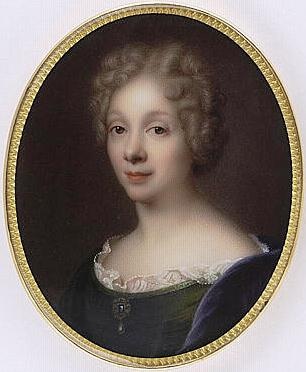
Anne Le Fèvre Dacier
. . . . . . . . . .
Working as an editor
After her father’s untimely death in 1672, Anne moved to Paris to earn a living as an editor and commentator for the Delphin Classics. Read More→
The post Anne Dacier, translator of Homer’s The Iliad and The Odyssey appeared first on Literary Ladies Guide.
]]>She is best known for the prose translation of the Homeric epics from the original Greek language into French, a fifteen-year labour of love published as L’Iliade in 1711 and L’Odyssée in 1716.
The French editions were then translated into English by famed poet Alexander Pope, and published in 1715–20 for The Iliad and in 1725–26 for The Odyssey.
Raised in a Protestant family in Saumur, a town in western France, Anne Le Fèvre was taught Latin and Greek by her father Tanneguy Le Fèvre, a classic scholar who went against the tendencies of his time by giving his daughter a good education along with her brothers. She showed him her gratitude by signing her first works with the mention Anna Tanaquilli Fabri filia (Anne, Daughter of Tanneguy Le Fèvre).
Anne’s first husband was Jean Lesnier, a much older printer-bookseller who was a friend of her father’s. She separated from him in 1670 after the death of their son three weeks after his birth. Jean Lesnier died five years later, in 1675.
. . . . . . . . . .
Anne Le Fèvre Dacier
. . . . . . . . . .
After her father’s untimely death in 1672, Anne moved to Paris to earn a living as an editor and commentator for the Delphin Classics. The Delphin Classics (Ad usum Delphini in Latin, meaning “For the use of the Dauphin”) were a series of annotated editions of Latin and Greek classics published under the supervision of French scholar Pierre Daniel Huet, another friend of her father.
Pierre Daniel Huet was one of the tutors of the Dauphin Louis of France, the eldest son of King Louis XIV. The Delphin Classics were intended to contribute to the Dauphin’s education but they went far beyond that. The 64 volumes published between 1670 and 1698 became a literary institution.
Anne was the only woman in a team of prominent scholars. She first annotated a new Latin edition of Roman poet Publius Annius Florus (in 1674), which was widely praised while readers were very surprised to discover that its editor was a woman.
Anne edited some works by Greek poet Callimachus (in 1675, independently, from her father’s manuscript), by Greek chronicler Dictys Cretensis (in 1680), and by Roman historians Aurelius Victor (in 1681) and Eutropius (in 1683). To produce new Greek or Latin editions of these works meant writing a long preface, many notes and extensive commentary.
But readers now preferred annotated French editions to annotated Latin editions. French definitively supplanted Latin in the literary world, hence the need for translations in the Delphin Classics. Anne and her colleagues switched from editing to translating.
Anne translated some works by Greek lyric poets Anacreon and Sappho (in 1681), by Greek comic playwright Aristophanes (in 1684), and by Roman comic playwrights Plautus (in 1683) and Terence (in 1688). The translations included a lengthy preface, a number of notes and a detailed commentary as well.
Anne Le Fèvre actively participated in the Quarrel of the Ancients and the Moderns (Querelle des anciens et des modernes). The literary quarrel opposed the Ancients, a group of classical writers led by poet Nicolas Boileau, and the Moderns, a group of writers who favored contemporary literature, led by author Charles Perrault (known for his fairy tales as a new literary genre). Unsurprisingly, Anne stood for the Ancients, who favored the classical authors she edited and translated.
Anne Le Fèvre married her colleague and friend André Dacier in 1683. He was a Protestant, a former student of her father, and a longtime editor of the Delphin Classics. The couple moved to Castres (André’s birthplace), a town in southern France, in 1684.
At their instigation, the whole town converted to Catholicism in 1685 to avoid persecution and destruction in a mainly Catholic country. They were rewarded by a pension granted by King Louis XIV, with 1,500 livres (the currency of the Kingdom of France) for André and 500 livres for Anne.
Back in Paris in 1686, Anne and André Dacier teamed up to translate Meditations by Roman philosopher Marcus Aurelius (1690–91) and the first six Parallel Lives by Greek philosopher Plutarch (1694). André Dacier was elected to the French Academy (Académie française) in 1695 and appointed keeper of the Library of the Louvre in 1702.
. . . . . . . . . . . .
. . . . . . . . . . . .
The first partial translations into French of the Homeric poems were signed by the Renaissance scholars Jacques Pelletier du Mans and Amadis Jamyn in the 16th century. Pelletier du Mans translated the first two books of The Odyssey, published in 1547 with other translations. Jamyn translated part of The Iliad, published in 1580, and began a translation of The Odyssey that was left unpublished.
One century later, a loose translation (or more exactly an adaptation) of Homer’s epic poems was penned by French scholar Achille de La Valterie from a Latin edition, and published in 1681.
After reading La Valterie’s translation, Anne Dacier was outraged by the inaccuracies and liberties taken with the Homeric texts. She undertook a translation from the original Greek language, a major task to which she devoted fifteen years of her life.
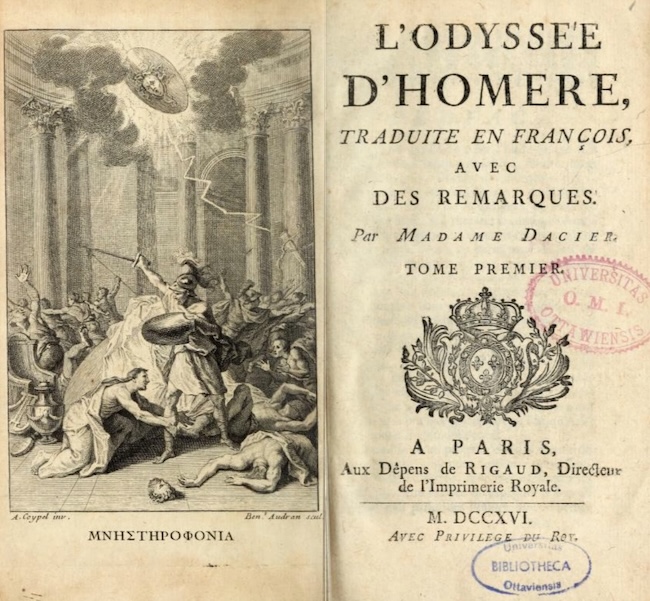
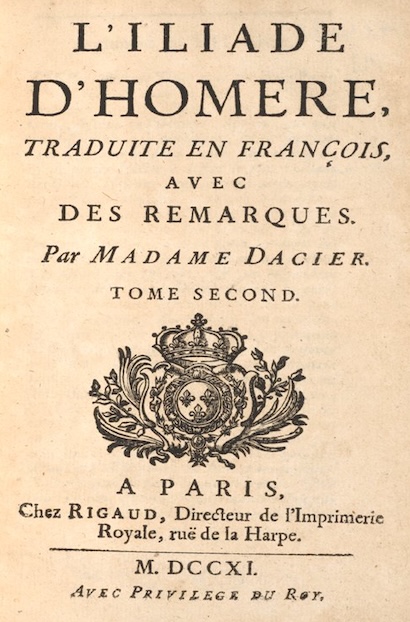
Her prose translations were published as the three-volume L’Iliade in 1711 and the three-volume L’Odyssée in 1716, with a long preface, numerous notes and extensive commentary.
Widely praised for their fidelity to the source texts, her two translations introduced Homer to her contemporaries and won over a large audience throughout Europe — French being the literary language by excellence —s while ensuring its translator’s fame.
. . . . . . . . . . . .
. . . . . . . . . . . .
Another French translation of The Iliad followed, this time by poet and academician Antoine Houdar de la Motte. Having little knowledge of Greek, Houdar de la Motte based his verse translation on Anne Dacier’s prose translation. The abridged verse edition was published in 1714 with just twelve instead of the twenty-four books of the full version. The text was modernized and — in the translator’s own words — improved upon the original.
An essay by Houdar de la Motte criticizing Homer’s literary merit was included in the translation under the title Discours sur Homère (Discourse on Homer), in which he explained the reasons why the epic poet failed to satisfy his own critical taste.
Deeply shocked by these criticisms, Anne Dacier rushed to Homer’s defense and penned a 445-page essay entitled Des causes de la corruption du goût (Of the Causes of the Corruption of Taste), published in 1715.
The two translators embarked on a lengthy literary debate over Homer’s talent and style, aptly named Querelle d’Homère (Quarrel of Homer) as the ultimate chapter of the Quarrel of the Ancients and the Moderns.
Other essays were penned by several prominent intellectuals, including academician Jean Terrasson, who sided with Houdar de la Motte, and philosopher Claude Buffier, who attempted to defuse the situation by demonstrating that Houdar de la Motte and Anne Dacier both celebrated Homer but in different ways.
The controversy ended in April( 1716 when the two literary rivals met at a supper they were both invited to. Houdar de la Motte finally agreed on the fact that Homer was a literary genius, and they both drank to the health of the great epic poet.
But French scholar Jean Hardouin, a former colleague of the Delphin Classics, went on with the debate in his own Apologie d’Homère (Apology of Homer), once again questioning the literary value of the Homeric texts.
Anne Dacier took up her pen again to write a 220-page essay entitled Homère défendu contre l’apologie du R. P. Hardouin (Homer Defended Against the Apology of Father Hardouin), published in 1716.
The lengthy controversy saddened the last years of her life. She died in 1720 from poor health and her husband André died two years later.
Anne Dacier’s translation of the Homeric epics was praised by many, including English poet Alexander Pope (1688–1744), who by his own account was fascinated by Homer since his childhood. As a young man, before joining the literary society in London, he read the Homeric poems in their entirety as well as classics by Roman poets Horace, Juvenal, and Virgil.
Homer’s epic poems had already been translated into English one century earlier by poet and playwright George Chapman, a contemporary of Shakespeare who translated several Greek and Latin classics during his lifetime. Chapman published The Iliad in installments from 1598 onwards before a full translation of the two epic poems, entitled The Whole Works of Homer and published in 1616.
In 1713, Pope announced his decision to work on a new verse translation of The Iliad and signed a contract the following year with the printer-publisher Bernard Lintot, who paid him the astounding fee of 200 guineas per volume. The six-volume translation was available by subscription, with one volume published every year over six years from 1715 to 1720.
The translation of The Iliad became a bestseller and Pope went on with the translation of The Odyssey, with equivalent wages but without the need for a subscription this time, with a publication in five volumes in 1725–26.
The money earned from his two bestselling translations allowed Pope to acquire a beautiful villa in Twickenham (west of London) in 1719, where he could create his famous romantic grotto (that survives to this day) and the gardens of his dreams, two major sources of inspiration for his new poems.
Much of Pope’s translation was based on Anne Dacier’s French translation, a fact that is well known but has regularly been downplayed or bypassed for three centuries. To translate an existing translation instead of the original work was common at the time but to translate an existing translation penned by a woman was still unheard of.
In the second French edition of The Iliad, published in 1719, Anne Dacier wrote an essay on Pope’s translation of the same work, which gained her some fame in England as well.
However, after the painstaking process of translating The Iliad on his own, Pope only translated twelve books of The Odyssey himself, and secretly enlisted the help of two other poets, William Broome (who translated eight books) and Elijah Fenton (who translated four books). The secret leaked out and damaged Pope’s reputation for some time, as well as some criticisms relating to Homer’s “wild paradise” reduced to “order”, with no incidence on the sales of his two bestselling translations.
. . . . . . . . . . . .
. . . . . . . . . . . .
With the exception of scholar Paul Tallemant, an influential member of the Moderns who penned an epigram criticizing her husband in order to attack her, Anne Dacier was widely praised in the French literary world.
Scholar Gilles Ménage dedicated his history of women philosophers (Historia mulierum philosopharum, 1690) to her and described her in the introduction as “the most learned of women whether of the present or the past.”
Poet Nicolas Boileau praised her in the preface to his translation of On the Sublime (Traité du sublime, revised edition, 1701), a treatise penned by an unknown Greek author in the 1st century, writing about “this learned woman … who now works to make us read Aristophanes, Sophocles, and Euripides in French”.
She was also celebrated by philosophers Voltaire and Jean de La Bruyère, by fabulist Jean de La Fontaine, by memoirist Henri de Saint-Simon, by literary critic Charles Augustin Sainte-Beuve, and by many others.
Being a learned woman who was respected by her peers didn’t entirely prevent misogynistic comments from prominent male scholars. As stated by German philosopher Immanuel Kant in his Observations on the Feeling of the Beautiful and Sublime (originally published in German in 1764):
“A woman who has a head full of Greek, like Madame Dacier, or who conducts disputations about mechanics, like the Marquise du Châtelet, might as well also wear a beard; for that might perhaps better express the mien of depth [the overall appearance] for which they strive.”
But Kant certainly read their works which probably influenced his own writings.
During the Golden Age of American comics in the mid-20th century, Anne Dacier was the heroine of a two-page biographical comic strip in the Wonder Women of History series included in Wonder Woman (number 48, 1951), the famed comic book series published by DC Comics.
She was recognized as a pioneering intellectual whose life reflected the spirit of emancipation embodied by the Wonder Woman character. She overcame the barriers imposed by her gender to become a renowned and respected editor and translator of ancient texts, including the famous Homeric poems.
Contributed by Marie Lebert. Marie is a bilingual French-English translator. She has worked as a translator and/or librarian for international organizations and has written ebooks, articles and essays about translation and translators, ebooks, libraries and librarians, and medieval art. She holds a doctorate of linguistics (digital publishing) from the Sorbonne University, Paris, and a master of social science (society and culture) from the University of Caen, Normandy. See more entries by Marie Lebert, most profiling women translators, on Literary Ladies Guide. Find more about women translators of the past at Marie Lebert.
The post Anne Dacier, translator of Homer’s The Iliad and The Odyssey appeared first on Literary Ladies Guide.
]]>Her contemporaries largely marginalized her work, despite the name she made for herself in Danish literary circles.
Ditlevsen’s work has seen a resurgence with the reissue of much of her body of work, especially the autofictional Copenhagen Trilogy, which has been translated into some thirty languages.
Tove Ditlevsen’s working-class roots
Tove Irma Margit Ditlevsen was born in Copenhagen in 1917. She grew up in Vesterbro, which was then a working-class district, with her parents and older brother, Edvin. Her father was a coal stoker.
In the Copenhagen Trilogy, Ditlevsen wrote, “Down at the bottom of my childhood my father stands laughing. He’s big and black and old like the stove, but there is nothing about him that I’m afraid of.”
Her mother, on the other hand, was, “Beautiful, untouchable, lonely, and full of secret thoughts I would never know …” Her capricious temper ruled the household, and the young Tove would often find herself on the end of her mother’s “dark anger [that] always ended in her slapping my face or pushing me against the stove.”
It was an unhappy childhood. Ditlevsen recalled: “Time passed and my childhood grew thin and flat, paper-like. It was tired and threadbare, and in low moments it didn’t look like it would last until I was grown up.”
Early forays into poetry
Despite her father’s warning that “a girl can’t be a poet,” Ditlevsen began writing poems at the age of ten. Read More→
The post Tove Ditlevsen, Danish author of The Copenhagen Trilogy appeared first on Literary Ladies Guide.
]]>Her contemporaries largely marginalized her work, despite the name she made for herself in Danish literary circles.
Ditlevsen’s work has seen a resurgence with the reissue of much of her body of work, especially the autofictional Copenhagen Trilogy, which has been translated into some thirty languages.
Tove Irma Margit Ditlevsen was born in Copenhagen in 1917. She grew up in Vesterbro, which was then a working-class district, with her parents and older brother, Edvin. Her father was a coal stoker.
In the Copenhagen Trilogy, Ditlevsen wrote, “Down at the bottom of my childhood my father stands laughing. He’s big and black and old like the stove, but there is nothing about him that I’m afraid of.”
Her mother, on the other hand, was, “Beautiful, untouchable, lonely, and full of secret thoughts I would never know …” Her capricious temper ruled the household, and the young Tove would often find herself on the end of her mother’s “dark anger [that] always ended in her slapping my face or pushing me against the stove.”
It was an unhappy childhood. Ditlevsen recalled: “Time passed and my childhood grew thin and flat, paper-like. It was tired and threadbare, and in low moments it didn’t look like it would last until I was grown up.”
Despite her father’s warning that “a girl can’t be a poet,” Ditlevsen began writing poems at the age of ten. She later described these as “long, mysterious words [that] began to crawl across my soul like a protective membrane. A song, a poem, something soothing and rhythmic and immensely pensive, but never distressing or sad, as I knew the rest of my day would be distressing and sad.”
Ditlevsen began submitting these poems to literary magazines while in her teens. Meanwhile, she left school at sixteen to help her family financially, working at a series of low-paying jobs, including typist, stock clerk, and receptionist. Still, she continued to write.
Her first published poem appeared in the Danish journal Vild Hvede (Wild Wheat) in 1937. Her first poetry collection, Pigesind (From A Girl’s Mind) was published in 1939.
Following these early poetry collections, she produced a book every year or two until her death. It was a remarkably prolific output that included eleven books of poetry, seven novels, four collections of short stories, and the Copenhagen Trilogy – as well as countless articles and a long-running “agony aunt” column in the women’s weekly Familie Journalen.
. . . . . . . . . .
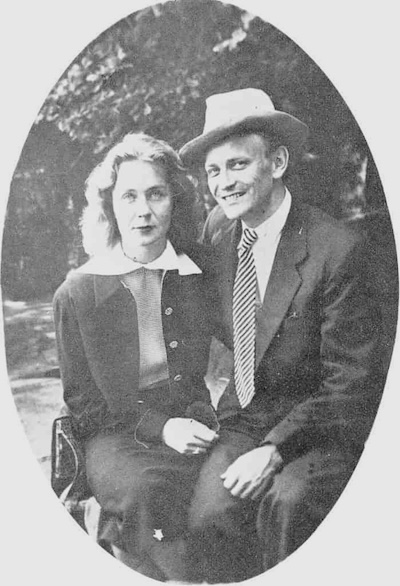
Ditlevsen with fourth husband Victor Andraesen in 1951
Photo courtesy of Wikimedia Commons
. . . . . . . . . .
Ditlevsen married four times. Her first husband, Viggo F. Møller, whom she married in 1940, was the editor of Vild Hvede. They married three years after this journal published Ditlevsen’s poetry. She was twenty-two to his fifty-two; the marriage lasted just over a year.
She initially attributed her early literary success to Møller but later observed, “It probably wasn’t necessary to marry him to move up in the world, but no one had ever told me that a girl could make something of her own.”
After she and Møller divorced, she married Ebbe Munk in 1942. They had one daughter, Helle, born in 1943, but this marriage didn’t last much longer than the first. By 1945, she and Munk had divorced, and she married to Carl T. Ryberg, a physician. They had a son, Michael, born in 1946. Ryberg had a daughter, Trine, from a previous marriage.
This was a deeply unhappy time for Ditlevsen. She became addicted to prescription drugs (partly due to Ryberg, who supplied her with them), in particular Demerol. She nearly died before seeking treatment. In 1949, she was admitted to a psychiatric ward – the first of several brief in-patient stays.
In 1951, she married Victor Andraesen, the editor of the tabloid newspaper Ekstrabladet. This was the longest of her marriages, lasting for twenty years before ending in an acrimonious divorce.
. . . . . . . . . .
. . . . . . . . . .
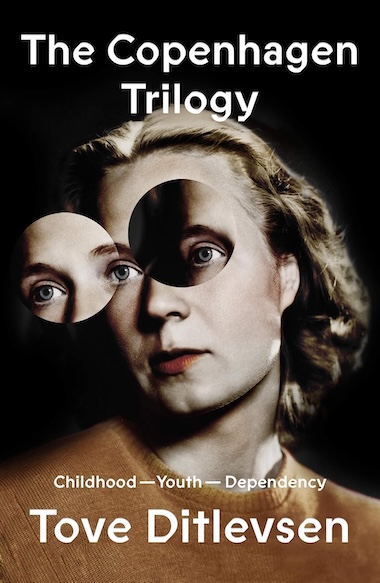
Much of Tove Ditlevsen’s work drew on her own experiences, and dealt with themes of love, class, addiction and mental illness, particularly as they pertained to women. Arguably the best-known example is the Copenhagen Trilogy, first published separately as Barndom (Childhood, 1967), Ungdom (Youth, 1967) and Gift (Dependency, 1971).
The trilogy charted her life from her childhood in Vesterbro through her teen years and early adulthood to marriage, childbirth, and addiction. Perhaps appropriately, Gift in Danish translates to both “married” and “poison” in English – an apt summing-up of how she experienced love. (Note, English editions of Gift are titled Dependency.)
The three books, however, aren’t a straightforward autobiography: scholar Sherilyn Hellberg pointed out that Ditlevsen was “constantly playing with this line between biography and fiction.” Today, the trilogy is often considered autofiction.
. . . . . . . . . .
. . . . . . . . . .
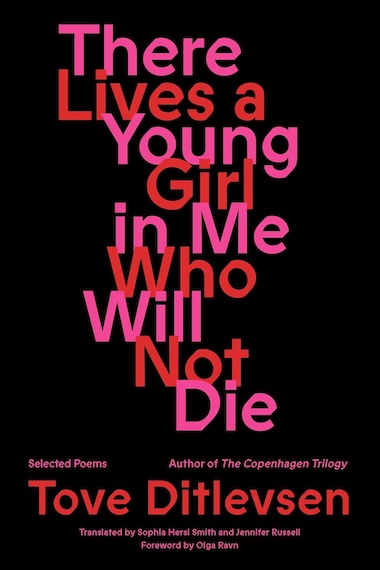
Tove Ditlevsen’s poetry was rich in themes similar to those in her prose works, particularly class and the role of women in society. The first collection to appear in English was There Lives a Young Girl in Me Who Will Not Die, translated by Sophia Hersi Smith and Jennifer Russell (2005).
In her poems, she often alluded to the “strange alienation” of housework and childrearing, and to her experiences of domestic abuse and illegal abortions. In the titular poem “There Lives a Young Girl in Me Who Will Not Die,” she wrote, “You had a girl’s dream of a husband and baby, / and you got what you wanted but were still alone.”
In the 1955 poem “Marriage,” she summed up her view of married life as “unknowingly coerced / into a lawful death of love.”
Her poetry was often critiqued as old-fashioned. She continued to write in rhyming verse well into the 1960s, while many of her contemporaries were shifting the poetic form into something freer and less rigid. In a 2005 TV interview, the author Klaus Rifbjerg commented, “She wrote rhyming poems, which were well crafted and well formulated, but were a kind of corset she had squeezed herself into…”
Another Danish author and poet, Olga Ravn, however, has argued that the subjects of Ditlevsen’s poems weren’t seeking anything new. Rather, they sought:
“… to review what has been cast off by tradition, the poetic scraps on the garbage heap. Why do they want to do that? Because using an archaic register is a working-class poet’s middle finger to the hoity-toity modernists and, at the same time, a way of resurrecting discarded language. With this discarded language, it’s possible to express an experience that cannot be articulated in the prevailing forms.”
Ditlevsen never self-described as a feminist, yet has been labelled a “woman’s writer” who, according to Dorthe Nors, is “loved by generations of women and put down by generations of men … [She is] the Billie Holiday of poetry… her prose turned the dreams and disappointments of life as a woman inside out.”
Olga Ravn notes Ditlevsen’s commitment to working-class literature:
“The revolutionary subject has always been presumed to be the man at the factory. But when women bring children into the world, children who grow up to go to the factory, work is being done… Hence, women’s literature about their own bodies and housework is workplace literature. Tove Ditlevsen was a worker’s writer.”
Despite achieving fame in her lifetime (she regularly appeared in newspapers and magazines for interviews and photoshoots), her place in the literary canon has long been disputed. According to Sherilyn Hellberg, Ditlevsen has,
“… been largely overlooked in this very male, very European tradition of modernism… Just talking about reading her seems to inspire all these really strong emotional reactions. There were all these debates about should Ditlevsen actually be read and was she worthy of being an object of literary criticism. It was really bizarre but also fascinating.”
Ditlevsen received many literary prizes, including De Gyldne Laurbær (The Golden Laurel) prize in 1955, a prestigious award bestowed by booksellers. Yet she still felt rejected by the literary establishment, particularly by the Danish Academy — she was never offered membership or its annual award.
Tove Ditlevsen took her own life at the age of fifty-eight by overdosing on sleeping pills. Photographs of her funeral show a crowd of working-class women following behind her coffin through the streets of Copenhagen.
. . . . . . . . . .
Contributed by Elodie Barnes. Elodie is a writer and editor with a serious case of wanderlust. Her short fiction has been widely published online and is included in the Best Small Fictions 2022 Anthology published by Sonder Press. She is Books & Creative Writing Editor at Lucy Writers Platform, she is also co-facilitating What the Water Gave Us, an Arts Council England-funded anthology of emerging women writers from migrant backgrounds. She is currently working on a collection of short stories, and when not writing can usually be found planning the next trip abroad, or daydreaming her way back to 1920s Paris. Find more of her writings here and on Literary Ladies Guide.
. . . . . . . . . .
Major Works
Ditlevsen was quite prolific. Relatively few of her works have been translated to English from their original Danish. Her first book, a collection of poems, was published in 1939; her last, also a collection of poems, was published in 1978. Here is her full bibliography.
English translations:
Further reading
The post Tove Ditlevsen, Danish author of The Copenhagen Trilogy appeared first on Literary Ladies Guide.
]]>Her writing spanned thirty years and nearly thirty books, covering subjects such as marginalization, oppression, and inequality, as well as racial, political, and sexual identity.
She was also passionate about the use of Black English in writing and in education, and had a thriving teaching career in several universities.
Early life in New York
June Millicent Jordan was born in the Harlem section of New York City in 1936 and raised in Bedford-Stuyvesant, Brooklyn. Her parents, Mildred and Granville Jordan were immigrants from Panama and Jamaica, respectively. An only child, she had a difficult relationship with her father, who never hid his disappointment that she was not a boy.
Later, she would write, “For a long while during childhood I was relatively small, short, and, in some other ways, a target for bully abuse. In fact, my father was the first regular bully in my life.” However, she credited him with passing along his love of literature, and by age seven, she began writing her own poetry. Her mother later took her own life. Fifteen years later, in a 1981 essay called “Many Rivers To Cross,” Jordan wrote:
“I thought about the idea of my mother as a good woman and I rejected that, because I don’t see why it’s a good thing when you give up, or when you cooperate with those who hate you…I came too late to help my mother to her feet. By way of everlasting thanks to all the women who have helped me to stay alive I am working never to be late again.”
She attended Midwood High School in Brooklyn for a year, Read More→
The post “I Do Not Consent” The Life of Writer and Activist June Jordan appeared first on Literary Ladies Guide.
]]>Her writing spanned thirty years and nearly thirty books, covering subjects such as marginalization, oppression, and inequality, as well as racial, political, and sexual identity.
She was also passionate about the use of Black English in writing and in education, and had a thriving teaching career in several universities.
June Millicent Jordan was born in the Harlem section of New York City in 1936 and raised in Bedford-Stuyvesant, Brooklyn. Her parents, Mildred and Granville Jordan were immigrants from Panama and Jamaica, respectively. An only child, she had a difficult relationship with her father, who never hid his disappointment that she was not a boy.
Later, she would write, “For a long while during childhood I was relatively small, short, and, in some other ways, a target for bully abuse. In fact, my father was the first regular bully in my life.” However, she credited him with passing along his love of literature, and by age seven, she began writing her own poetry. Her mother later took her own life. Fifteen years later, in a 1981 essay called “Many Rivers To Cross,” Jordan wrote:
“I thought about the idea of my mother as a good woman and I rejected that, because I don’t see why it’s a good thing when you give up, or when you cooperate with those who hate you…I came too late to help my mother to her feet. By way of everlasting thanks to all the women who have helped me to stay alive I am working never to be late again.”
She attended Midwood High School in Brooklyn for a year, followed by the elite Northfield School in Massachusetts. The student bodies of both schools were predominantly white. In 1953, she attended Barnard College in New York (the women’s college affiliated with Columbia University), but also felt alienated as a Black student, and by the white-centered curriculum. In her 1981 book of essays, Civil Wars, she wrote of the experience:
“No one ever presented me with a single Black author, poet, historian, personage, or idea for that matter. Nor was I ever assigned a single woman to study as a thinker, or writer, or poet, or life force.” Because of this disconnect, Jordan left Barnard without graduating.
. . . . . . . . . .
. . . . . . . . . .
In 1955, Jordan met and married Michael Meyer, a white student at Columbia University. She followed him to the University of Chicago, where she also enrolled, but ultimately returned to Barnard and graduated with a Bachelor of Arts degree in 1957.
In 1958, she gave birth to the couple’s only child, Christopher, and raised him alone after she and Meyer divorced in 1965.
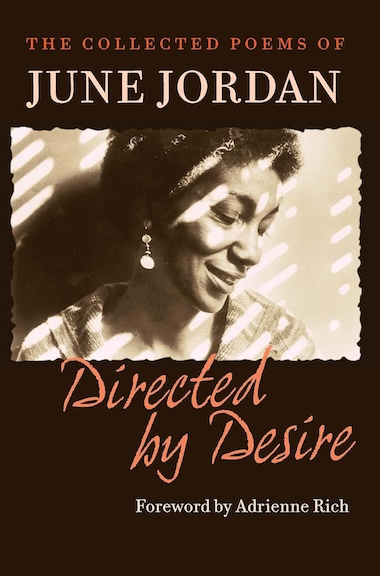
Jordan always identified openly as bisexual, saying, “Bisexuality means I am free and I am as likely to want to love a woman as I am likely to love a man, and what about that? Isn’t that what freedom implies?” After her death in 2019, she was one of the first fifty American “pioneers, trailblazers and heroes” inducted into the National LGBTQ Wall of Honor at the Stonewall National Monument in New York City.
Jordan was active in the civil rights, feminist, anti-war, and gay rights movements. She attended rallies, marches, events and conferences throughout her life. She wrote in Civil Wars: Selected Essays (Boston: Beacon Press, 1981).
“It seems unreasonable that more than 400 million people, right now, struggle against hunger and starvation, even while there is an arable earth aplenty to feed and nourish every one of us. It does not seem reasonable that the color of your skin should curse and condemn all your days and the days of your children. It seems preposterous that gender, that being a woman, anywhere in the world, should elicit contempt, or fear, or ridicule, and serious deprivation of rights to be, to become, to embrace whatever you choose…”
After the Harlem Riots of 1964 (in which James Powell, a Black teen, was shot dead by an NYPD officer – a shooting which sparked six nights of rioting and clashes between protestors and the police), Jordan was “filled with hatred for everything and everyone White.”
It was a conversation with civil rights leader Fannie Lou Hamer that led her to eventually believe that “this condition, if it lasted, would mean that I had lost the point: not to resemble my enemies, not to dwarf my world, not to lose my willingness and ability to love.”
After the riots, she collaborated with architect Buckminster Fuller on an architectural redesign of Harlem to improve living conditions for residents. However, the plan was never developed.
Jordan was also a passionate supporter of Palestinian rights, and said that the Palestinian struggle was the “moral litmus test” of her life. After traveling to Lebanon in 1982 and visiting the Sabra and Shatila refugee camps, and seeing the devastation of the Israeli massacres there firsthand (and then returning in 1996), she wrote in the poem “Apologies to All the People in Lebanon”:
“Yes I did know it was the money I earned as a poet that / paid / for the bombs and the planes and the tanks / that they used to massacre your family… I’m sorry. I really am sorry.”
. . . . . . . . . .
. . . . . . . . . .
Jordan’s teaching career began in 1967 when, after running poetry workshops for children in Harlem, she began teaching at the City College of New York. Later, she taught at Yale University and Sarah Lawrence College, and became Professor of English at Stony Brook, where she directed the Poetry Center.
In 1988, she became Professor of African American Studies at the University of California at Berkeley, where, in 1991, she co-founded Poetry for the People with Janice Mirikitani – a program to train undergraduates to bring poetry into community groups as a form of political and social empowerment.
She was known for using Black English both in her own writing and in her teaching. She saw it as a vital way of keeping the community and culture alive, and she encouraged her students to respect it as its own language and to use it in their own work.
Her essay, “Nobody Means More to Me Than You and the Future Life of Willie Jordan,” criticizes the use of “White English” as standard English, saying that “compulsory education in American compels accommodation to exclusively White forms of ‘English.’”
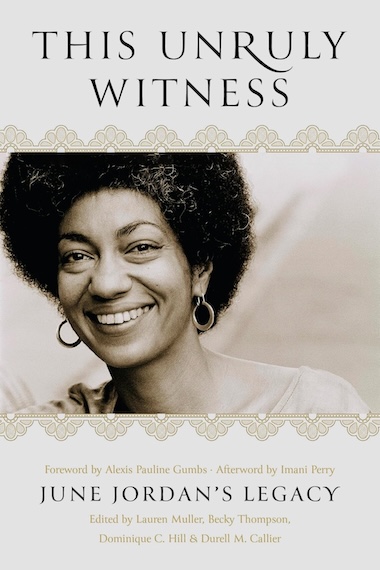
In 1969, Jordan published her first volume of poetry, Who Look at Me. This was followed by several books for children and young adults, including His Own Where (1971), Dry Victories (1972), New Life, New Room (1975), and Kimako’s Story (1981).
Later, she explored her own childhood in the memoir Soldier: A Poet’s Childhood (2000), and in a NewsHour interview with Elizabeth Farnsworth, she said of the book,
“I wanted to honor my father, first of all, and secondly, I wanted people to pay attention to a little girl who is gifted intellectually and creative, and to see that there’s a complexity here that we may otherwise not be prepared to acknowledge or even search for…” In a separate interview, she said, “My father was very intense, passionate, and over-the-top. He was my hero and my tyrant.”
She also wrote poetry and fiction, and librettos for the operas Bang Bang Uber Alles, and I was Looking at the Ceiling and Then I Saw the Sky. Her journalism was published widely, and she was a regular columnist for The Progressive. Her essays were largely political, and in collections such as Civil Wars (1981), On Call (1985), and Technical Difficulties (1992), her topics ranged from conflicts in South Africa, Nicaragua, and Lebanon, to issues of race and class in the U.S.
Jordan often wrote about her personal experiences in her work, including the experience of being raped. In ‘Poem About My Rights’, she wrote, “I have been raped / be- / cause I have been wrong the wrong sex the wrong age / the wrong skin the wrong nose the wrong hair the / wrong need the wrong dream the wrong geographic / […] / but let this be unmistakeable this poem / is not consent I do not consent / […] / I am not wrong: wrong is not my name”
When she was asked about the role of a poet in society, she replied, “The role of a poet, beginning with my own childhood experience, is to deserve the trust of people who know that what you do is work with words … Then the task of a poet of color, a Black poet, as a people hated and despised, is to rally the spirit of your folks …”
She was awarded a number of prestigious grants, including Fellowships from the National Endowment for the Arts, Massachusetts Council on the Arts, and the New York Foundation for the Arts, as well as the National Association of Black Journalists Award and a Rockefeller Foundation Grant. She was also a finalist for the National Book Award in 1972 for His Own Where.
. . . . . . . . . .
. . . . . . . . . .
Jordan was diagnosed with breast cancer in the 1990s, but continued to teach, write, and protest. She died in June 2002 at her home in Berkeley, California.
In an obituary, Lynell George wrote in the Los Angeles Times, “[Jordan] spent her life stitching together the personal and political so the seams didn’t show,” while Jordan’s contemporary, Toni Morrison, said of her career, “I am talking about a span of forty years of tireless activism coupled with and fueled by flawless art.”
. . . . . . . . . .
Contributed by Elodie Barnes. Elodie is a writer and editor with a serious case of wanderlust. Her short fiction has been widely published online and is included in the Best Small Fictions 2022 Anthology published by Sonder Press. She is Books & Creative Writing Editor at Lucy Writers Platform, she is also co-facilitating What the Water Gave Us, an Arts Council England-funded anthology of emerging women writers from migrant backgrounds. She is currently working on a collection of short stories, and when not writing can usually be found planning the next trip abroad, or daydreaming her way back to 1920s Paris. Find more of her writings here and on Literary Ladies Guide.
Further reading
The post “I Do Not Consent” The Life of Writer and Activist June Jordan appeared first on Literary Ladies Guide.
]]>Photo at right: Miriam Karpilove, from the collection of David Karpilow.
Karpilove became well known for her serialized novels in the American Yiddish press, focusing on the lives of young Jewish women and exploring contemporary issues of gender roles, sexual mores, immigration, and cultural dislocation.
Early life and emigration from Belarus
Karpilove was born in a small town near Minsk, Belorussia (now Belarus) in 1888, though the exact date is unknown. She was the fifth of ten children in an observant household. Her father, Elijah, was a lumber merchant and builder. Her mother, Hannah, encouraged the secular and religious education of all their children, including the girls.
Karpilove was an early lover of literature, especially Russian, and composed her own poetry in the language. She trained as a photographer and photographic retoucher.
She emigrated to the US in 1905, one of thousands of Jews who were fleeing the Russian Empire as a result of economic hardship, antisemitic pogroms, and restrictions on Jewish life under Tsarist rule. She settled in New York City, among the growing communities of Eastern European Jews on the Lower East Side, and supported herself with work in a photography studio. Some of her brothers, who also emigrated, settled in Bridgeport, Connecticut.
Writing life in New York
Karpilove published her first writing in 1906, in the Yiddish newspaper Di idishe fon. This was the start of a fifty-year career during which she wrote short stories, novels, novellas, sketches, criticism, and play scripts.
Nearly all her work appeared in Yiddish newspapers and periodicals such as Tog, Read More→
The post Miriam Karpilove, Yiddish-Language Writer appeared first on Literary Ladies Guide.
]]>Photo at right: Miriam Karpilove, from the collection of David Karpilow.
Karpilove became well known for her serialized novels in the American Yiddish press, focusing on the lives of young Jewish women and exploring contemporary issues of gender roles, sexual mores, immigration, and cultural dislocation.
Karpilove was born in a small town near Minsk, Belorussia (now Belarus) in 1888, though the exact date is unknown. She was the fifth of ten children in an observant household. Her father, Elijah, was a lumber merchant and builder. Her mother, Hannah, encouraged the secular and religious education of all their children, including the girls.
Karpilove was an early lover of literature, especially Russian, and composed her own poetry in the language. She trained as a photographer and photographic retoucher.
She emigrated to the US in 1905, one of thousands of Jews who were fleeing the Russian Empire as a result of economic hardship, antisemitic pogroms, and restrictions on Jewish life under Tsarist rule. She settled in New York City, among the growing communities of Eastern European Jews on the Lower East Side, and supported herself with work in a photography studio. Some of her brothers, who also emigrated, settled in Bridgeport, Connecticut.
Karpilove published her first writing in 1906, in the Yiddish newspaper Di idishe fon. This was the start of a fifty-year career during which she wrote short stories, novels, novellas, sketches, criticism, and play scripts.
Nearly all her work appeared in Yiddish newspapers and periodicals such as Tog, Kibitser, Forverts, Yidisher Kemfe, and Fraye Arbeter Shtime, and more than twenty of her novels were serialized (only five appeared in book form in her lifetime).
The Yiddish press, like the wider American press at that time, was largely male dominated. Karpilove was one of the very few women able to make a living from writing. Her work was hugely popular with readers, particularly female readers, but was mostly ignored by (male) critics of the time.
Throughout her writing career, Karpilove explored American urban life from the perspective of Jewish women, often young and independent immigrants, and portrayed themes of emotional isolation, cultural dislocation, sexual vulnerability, and the rapid social changes of the period.
She was frank about romantic and sexual encounters, although virginity and marriage remained ideals for most of her heroines – not out of prudishness, but as a critique of the way the new social and sexual trends left women vulnerable and often exploited.
. . . . . . . . . .
. . . . . . . . . .
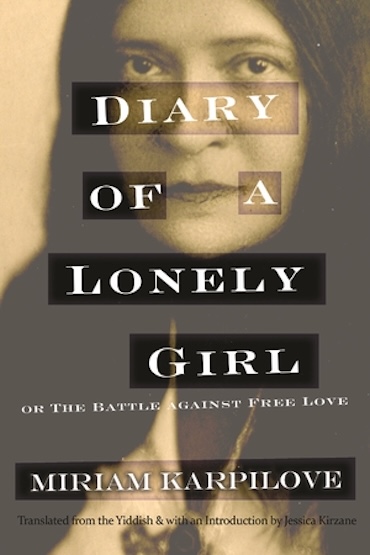
Her breakthrough novel, Tagebukh fun an elender meydele, oder Der kamf kegen fraye libe (Diary of a Lonely Girl, or the Battle Against Free Love) was serialized in Di Varhayt from 1916-1918, before being published in book form in 1918.
The story is told through the diary entries and letters of an unnamed protagonist as she writes, in wry detail, of her love life among the tenements of New York’s Lower East Side. She rejects both the idea of arranged marriages from the “old world culture” and “free love.” The latter, condoning extramarital affairs with no commitment, was advocated by the secular, radical Bohemians of the “new culture.”
The novel contrasts male entitlement with the lack of real autonomy for women, highlighting the disproportionate social and legal consequences that women could face as a result of men’s pursuit of “free love.”
Under the 1909 Tenement Act, for example, a woman could be evicted or arrested for prostitution simply for having a male visitor in her rented room. Unsurprisingly, there were no such consequences for the male visitors. In one diary entry, the protagonist writes, “If free is what you want, don’t force me.”
Similarly, Yudis (Judith) is an epistolary novel that explores the relationship between a small-town Jewish girl, uprooted by antisemitic violence, and her revolutionary lover Joseph. In her letters, Judith details the experiences and challenges faced by young Jewish immigrant women who move between old and new worlds and navigate shifting cultural ideas.
Karpilove often wrote from her own life experiences. Her 1909 play In di shturm teg (In the Stormy Days) drew on her childhood in the Russian Empire, while another serialized novel, A Provincial Newspaper (1926), explored an early-career female journalist’s struggles with overt sexism in the workplace.
From 1929 to 1937, she served as a staff writer for the renowned Yiddish newspaper Forverts. She published seven novels and several short stories there during that time, as well as reporting on current events, and contributing personal observations and opinion pieces on topics such as labor conditions and the culture of the Jewish community.
Karpilove became active in the Labor Zionist movement upon her arrival in the US. Her brother Jacob, whom she was close to and who settled in Bridgeport, became a prominent Zionist leader in the Poale Tsion movement, and she was the secretary of the local chapter in New York.
In 1926, she traveled to Palestine, hoping to settle there permanently. Before departing (in something of a disorganized rush), she wrote to Chaim Liberman, Secretary of the Yiddish Writers’ Union:
“Yes, dearest of all secretaries, I am going to the land of Israel. I will be leaving in about a month, on the first of September, 1926 … My weak head is dizzy with all of the things that I have to do for myself in order to leave from golus [diaspora]. I am my own moshiyekh’te [lady messiah] and, as you know, I have no white horse and, as you also know, the subway is on strike to boot. Therefore please accept my apologies for my distance, my tardiness, in following the aforementioned rules and regulations …”
She returned from Palestine three years later, unable to make ends meet there. Her autobiographical novel A Novel About Israel: My Three Years in Israel chronicles her time there. It hasn’t been translated in full, but is held in her archive at the YIVO Institute for Jewish Research. An excerpt, translated by Jessica Kirzane, can be viewed here.
Karpilove wasn’t impressed with the British government mandate then in charge of the country. In the novel, she wrote of the government officials:
“They didn’t like us. I could tell. But we couldn’t ask them why…we just had to ignore their cold, dry demeanor towards us immigrants. I doubt if we’ll be able to accomplish much in Eretz Yisrael under the Mandate that they use to squeeze money out of us. We can only accomplish things that are in their interest. On the way to Eretz Yisrael, we heard our fill about their decency, but now all we could do was console ourselves with the hope that it won’t always be this way. Someday we’ll come to an agreement. We will prevail.”
. . . . . . . . . .
. . . . . . . . . .
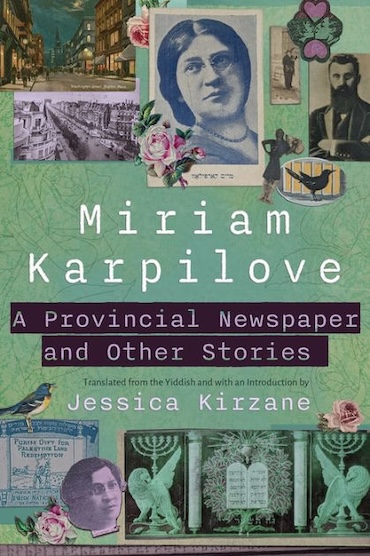
Karpilove has experienced a recent resurgence, thanks to the efforts of scholar Jessica Kirzane at the University of Chicago, whose translations have made her work more accessible. Syracuse University Press published Diary of a Lonely Girl, or the Battle for Free Love, in 2020, and A Provincial Newspaper and Other Stories in 2023. Judith: A Tale of Love and Woe was published by Farlag Press in 2022.
Karpilove kept scrupulous lists of what she wrote, where and when it was published. This makes it possible to get a fuller view of her writing life compared with other women’s, whose writing has been lost. Contemporary scholars place her as a sophisticated observer of Jewish women’s life: Kirzane says that Karpilove gives the reader “a provocative, audacious portrait of Jewish womanhood that maybe we wouldn’t get in the same way elsewhere.”
However, there is also an acknowledgement that in many of Karpilove’s short stories, particularly those written during and after her time in Palestine, there is a distinct element of racism and orientalism that was common among Westerners at the time.
Her narrators often portray Arabs in a negative light, blaming their own moral failings and not systemic or political failure. Critic Sarah Imroff, in reviewing Kirzane’s translation of A Provincial Newspaper, wrote that, “With no critique internal to the stories, it is difficult to conclude that Karpilove herself did not also hold some of these views.”
Kirzane, in her introduction, wrote that, “It is important to note Karpilove’s racism in the text, particularly because she sees herself as outside of the ideologically strident voices calling for the exclusive use of Jewish labor over Arab labor.”
Karpilove never married or had children. Among her family, she was closest to her brother Joseph, and around 1938, she moved from New York to Bridgeport to help him care for his ailing wife, Annie. She then stayed to care for Joseph after Annie died.
From postcards written in the 1940s to her friend and fellow Yiddish writer Bertha Kling. It can be gleaned that she desperately missed the bohemian atmosphere of Yiddish New York and the gatherings at Kling’s home that she would once have been a part of.
She wrote that if she had still been in New York, she would not have missed a single meeting, and said, “I think it’s long overdue that women writers should have the chance to hear each other. The power has been in the hands of male writers for too long.”
In her later years, she suffered from ill health, although there are no specifics on record. She died in Bridgeport in early 1956, with various sources citing March or May.
Her great-nephew, David Karpilow, remembered her as “a woman ahead of her time … a strong feminist, an early beatnik…unique within the family. I recall her reading a lot and having strong opinions … she was an intellectual, certainly in her own way. Her experiences were vast.”
. . . . . . . . . .
Contributed by Elodie Barnes. Elodie is a writer and editor with a serious case of wanderlust. Her short fiction has been widely published online and is included in the Best Small Fictions 2022 Anthology published by Sonder Press. She is Books & Creative Writing Editor at Lucy Writers Platform, she is also co-facilitating What the Water Gave Us, an Arts Council England-funded anthology of emerging women writers from migrant backgrounds. She is currently working on a collection of short stories, and when not writing can usually be found planning the next trip abroad, or daydreaming her way back to 1920s Paris. Find more of her writings here and on Literary Ladies Guide.
Three books are available in English, all translated by Jessica Kirzane:
More about Miriam Karpilove
The post Miriam Karpilove, Yiddish-Language Writer appeared first on Literary Ladies Guide.
]]>Her work is noted for its lyrical depiction of women, sexuality, loneliness, emotional isolation, desire, survival, and rebellion. O’Brien is best known for her first novel, The Country Girls, which, upon its debut, was both denounced and lauded.
A prolific writer, O’Brien, challenged taboos of religion, sex, gender, patriarchy, and persecution.
The Early Years: A Lonely Country Girl
Josephine Edna O’Brien was born to Lena and Michael O’Brien in the rural village of Tuamgraney, County Clare. O’Brien was born into a newly independent Ireland, an Ireland free of British rule, but an Ireland where the Catholic Church and state largely controlled women’s lives. The youngest of four children, O’Brien’s childhood was marred by turbulence and tension.
From the outside, her family appeared to be prosperous. She lived in a large house on 600 acres of land, where her parents kept horses and employed farm workers, but money was scarce. O’Brien’s father was an unsuccessful horse breeder who gambled, drank, and was prone to violence.
Her mother, who described her as a lonely child, was fearful of books. The only books in the O’Brien house were bloodstock manuals and the Bible. There was no public library in the village. Despite this, O’Brien said she loved words and that words were her great companions and education.
Raised in a strict Catholic family, O’Brien received her formal early education at the Convent of Mercy, where she excelled in the sciences. Upon graduation, O’Brien obeyed her parents’ wishes and enrolled in a pharmaceutical college in Dublin, and then worked as a licensed pharmacist. It was here in Dublin that O’Brien began to write fiction for the literary magazine The Bell. Read More→
The post Edna O’Brien, Prolific Irish Author of The Country Girls appeared first on Literary Ladies Guide.
]]>Her work is noted for its lyrical depiction of women, sexuality, loneliness, emotional isolation, desire, survival, and rebellion. O’Brien is best known for her first novel, The Country Girls, which, upon its debut, was both denounced and lauded.
A prolific writer, O’Brien, challenged taboos of religion, sex, gender, patriarchy, and persecution.
Josephine Edna O’Brien was born to Lena and Michael O’Brien in the rural village of Tuamgraney, County Clare. O’Brien was born into a newly independent Ireland, an Ireland free of British rule, but an Ireland where the Catholic Church and state largely controlled women’s lives. The youngest of four children, O’Brien’s childhood was marred by turbulence and tension.
From the outside, her family appeared to be prosperous. She lived in a large house on 600 acres of land, where her parents kept horses and employed farm workers, but money was scarce. O’Brien’s father was an unsuccessful horse breeder who gambled, drank, and was prone to violence.
Her mother, who described her as a lonely child, was fearful of books. The only books in the O’Brien house were bloodstock manuals and the Bible. There was no public library in the village. Despite this, O’Brien said she loved words and that words were her great companions and education.
Raised in a strict Catholic family, O’Brien received her formal early education at the Convent of Mercy, where she excelled in the sciences. Upon graduation, O’Brien obeyed her parents’ wishes and enrolled in a pharmaceutical college in Dublin, and then worked as a licensed pharmacist. It was here in Dublin that O’Brien began to write fiction for the literary magazine The Bell.
. . . . . . . . . . .
. . . . . . . . . . .
In 1952, she met the Irish-Czech writer, Ernest Gébler, who was twenty years her senior. To escape her parents’ disapproval, O’Brien and Gébler eloped in 1954. After several moves, O’Brien and Gébler settled in London in 1960 with their two sons, Carlo and Sasha. Here, O’Brien found work reviewing manuscripts for the publishing house Hutchinson.
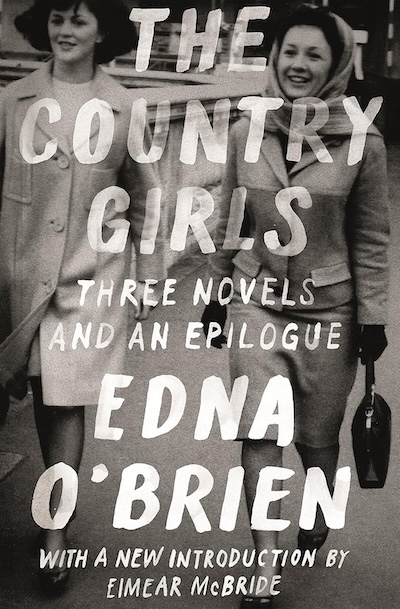
Ian Hamilton, who ran Hutchinson, was so impressed with her summaries that he and Blanche Knopf each advanced her £25, so she could write a novel. Written in three weeks and through many tears, The Country Girls novel was born. The novel had a polarizing effect on the public, and in her personal life, as well. O’Brien’s success put a strain on her marriage. Upon reading The Country Girls, her husband told her, “You can write and I will never forgive you.”
O’Brien eventually fled her marital home and divorced Gébler in 1968. O’Brien succeeded in winning custody of their two children after an acrimonious three-year custody battle and a promise that she would never allow her children to read her novel August is a Wicked Month. Years later, Gébler continued to attack her, claiming that he had written almost all of her early work.
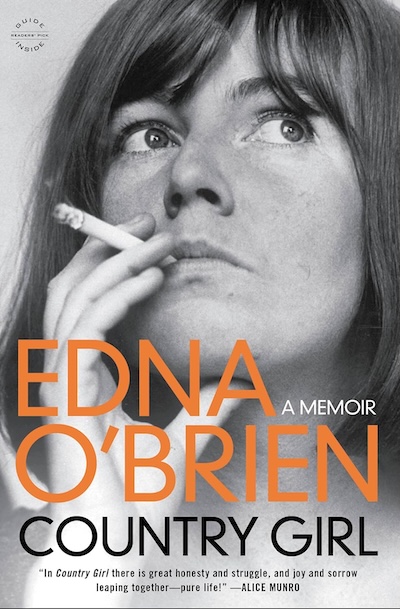
Her mother also disapproved of her being a writer. In her 2012 memoir, Country Girl, O’Brien writes that after her mother passed away, O’Brien discovered that her mother had inked out offensive language in her copy of The Country Girls.
The Country Girls scandalized her native Ireland, where it was banned and censored by the Catholic Church. While O’Brien’s novel was acclaimed and admired in places like London and New York, back in Ireland, it was labeled as “filth” by the Irish Minister of Justice. It was so controversial and had created such a furor that it was publicly burned in O’Brien’s childhood village. O’Brien said that people drew their curtains and treated her as if she were a Jezebel.
. . . . . . . . . . .
. . . . . . . . . . .
In the 1960s and 70’s, O’Brien led what was perceived by the public as a glittering, glamorous, and libertine lifestyle. This sometimes made it difficult for O’Brien to be taken seriously as a writer. As a single mother of two, she moved to the Chelsea neighborhood of London, where her home became a hub for artists, actors, writers, musicians, and other luminaries.
She threw parties in her Chelsea home, drawing guests like Marlon Brando, Jane Fonda, Paul McCartney, Judy Garland, Jackie Onassis, Mick Jagger, Vanessa Redgrave, J.D. Salinger, Samuel Beckett, Francis Bacon, Elizabeth Taylor, and Harold Pinter. To her dismay, critics began focusing more on her appearance, relationships, and social life than her writing.
While working in the Dublin pharmacy in her early 20s, she began reading works by Tolstoy, Thackeray, and O’Connor, among others, in her spare time. As a child, she had dreamed of becoming a writer, but it wasn’t until she learned that James Joyce’s A Portrait of the Artist as a Young Man was semi-autobiographical that she seriously contemplated becoming a writer herself.
James Joyce had a profound influence on her and her writing. She wrote nonfiction works about him: James and Nora (1981) and James Joyce (1999). At the age of 92, O’Brien wrote the play, Joyce’s Women. She said she learned more from Joyce than anyone else in the world. O’Brien so revered Joyce that she was able to quote from his works from memory. Her own writing style has been compared to Joyce’s with its Hiberno-English cadences, rhythms, and syntax.
Other literary heroes, such as Woolf, Byron, and Beckett, also became the subjects of plays and nonfiction works. She frequently spoke of her admiration for Chekhov, Tolstoy, Proust, Flaubert, the Brontë sisters, Sylvia Plath, and Shakespeare, and the impact and impressions they had made on her.
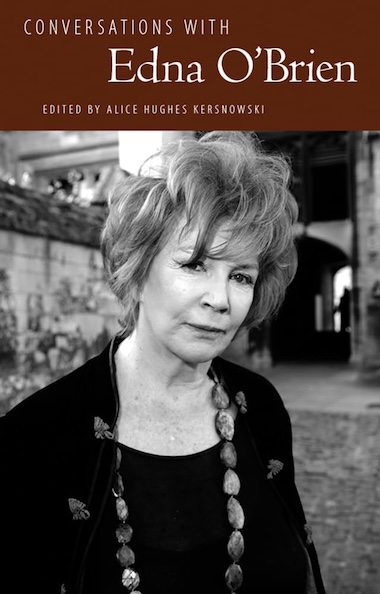
Books by her favorite writers were always open on her desk, and pictures of her favorite authors were displayed in her study. Her voracious appetite for reading made up for her lack of formal literary education.
. . . . . . . . . . .
. . . . . . . . . . .
O’Brien’s novels often depict themes such as the condition of women in society, control of women and their bodies, the insidiousness of patriarchy, love, loss, loneliness, and exile. Her writings dealt with the personal inner lives of characters, as well as politics, religion, and society.
O’Brien said that she wrote about the things we are not supposed to talk about. She wrote about topics like sexuality and repression (The Country Girls), incest and abortion (Down by the River), and sexual violence and survival (Girl). Her writing style has been described as lyrical and autobiographical, with her later novels focused on the universality of the female experience.
When her first novel, The Country Girls, came out, John Broderick of the literary magazine Hibernia ran a quote from O’Brien’s husband saying that O’Brien’s talent resided in her knickers. Like many female authors, O’Brien endured much casual sexism from critics, perhaps more than most.
Instead of focusing on her writing, reviews, and articles often focused on her appearance, her accent, and her love life. In an interview with Faber Books in 2012, O’Brien said, “It’s hard to be taken as seriously as men. It is unfair, but you know it’s a part of life. What counts is the dedication, the absolute fanatic determination, and I suppose love that one puts into the work.”
O’Brien sometimes drew criticism because her early work focused on love, and many of her characters could be perceived as “victims.” In an NPR interview in 2019, O’Brien herself said, “I’ve always written about girls and women, both as victims and as fighters combined, that duality. They’ve been through hell, and somehow they come through.”
O’Brien may be viewed as being ahead of her time as she raised controversial issues in her writing and lived a life of independence. In 2015, O’Brien signed a public letter advocating for the repeal of the Eighth Amendment to the Irish Constitution, which restricted women’s access to abortion in Ireland. Through her writing and her actions, O’Brien addressed the differences and difficulties women face, and paved the way for a new generation of female Irish writers.
. . . . . . . . . . .
. . . . . . . . . . .
“I live out of Ireland because something in me warns that I might stop if I lived there, that I might cease to feel what it has meant to have such a heritage….” (“Mother Ireland,” The Sewanee Review, Winter 1976)
O’Brien’s native land of Ireland permeates throughout her books and had a significant influence on her writings. Like her literary heroes, Joyce and Beckett, she too became a literary exile. O’Brien said that exile and separation were good for her and that she might not have otherwise written books.
She said she both loved and hated Ireland. Despite living in England, O’Brien proudly and fervently supported Irish nationalism and freedom from British colonialism. In 1972, she led a march to protest the incarceration of Irish Republican Army leader Seán Mac Stiofáin.
Throughout the 1990s, she followed the Northern Ireland peace negotiations and penned an open letter to then British Prime Minister Tony Blair, arguing that controversial former Sinn Féin President Gerry Adams should be included in political talks.
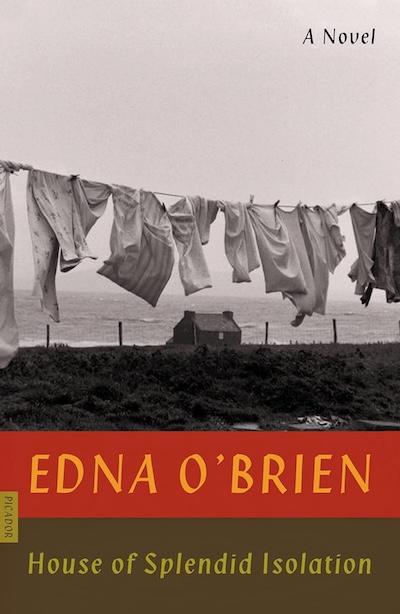
In 2006, O’Brien wrote a poem included in a book marking the 25th anniversary of Irish nationalist hunger strikes. Her novel, The House of Splendid Isolation, is considered to be an important novel about the “Troubles” in Northern Ireland. O’Brien endured heavy and disparaging criticism for her support of a United Ireland, but continued to courageously champion her ideals.
Despite her critics and controversies, O’Brien was the recipient of many awards throughout her career. Earlier prizes included the Kingsley Amis Award in 1962, the Los Angeles Times Book Prize in 1990, and the European Prize for Literature in 1995. O’Brien received a Lifetime Achievement Award at the 2012 Irish Book Awards.
In 2018, she won the Presidential Distinguished Service award for the Irish abroad, was appointed a Dame of the British Empire for her services to literature, and received the Pen Nabokov Award for Achievement in International Literature. In 2019, she received the David Cohen Prize for Literature. She was named Commander of the French “Ordre des Arts et Lettres” in 2021.
O’Brien received honorary doctorates from Galway University, Queen’s University Belfast, and the University of Limerick. In 2006, University College Dublin awarded her the Ulysses Medal. In 2015, she was made a member of Aosdána and was elected as a Saoi (wise one).
“I loved the idea of writing because it suggested to me that life itself could be rendered more deeply and beautifully than normal life as lived.” –The Irish Times, September 12, 1992
Edna O’Brien died in London, England, at the age of 93 after a long battle with cancer. Commended and controversial in her time, Edna O’Brien will forever be remembered as transforming Irish fiction.
Contributed by L.C. Canivan.
. . . . . . . . . . . .
Novels
Collections
Children’s Books
Short Stories/Novellas
Nonfiction
Anthologies
Dramas
Poetry Collection
The post Edna O’Brien, Prolific Irish Author of The Country Girls appeared first on Literary Ladies Guide.
]]>While living in Southern California during the Great Depression of the 1930s, Babb learned of the plight of the Dust Bowl migrants. She began working for the Farm Security Administration (FSA), taking detailed, copious notes about the lives of migrants.
Babb aimed to write a novel based on the notes, hoping that it would foster sympathy and understanding for the plight of migrant workers.
Her FSA boss, Tom Collins, introduced Babb to novelist John Steinbeck. Collins asked Babb if she would allow Steinbeck to review her notes. Random House already planned to publish Babb’s “exceptionally fine” novel, but before she finished it, Steinbeck’s Grapes of Wrath (1939) was flying off the shelves.
Random House canceled Babb’s book deal, claiming that there wasn’t room in the market for two novels about Dust Bowl migrants. It was only many years later that it came to light that Steinbeck used Babb’s notes extensively in writing The Grapes of Wrath. Babb didn’t seem to hold a grudge and went on to lead a singular and exceptional life.
The Early Life of Sanora Babb
Sanora Babb was born in 1907 in the Oklahoma Territory to Walter and Jennie Babb. Though white people settled the town, Red Rock sat in the midst of Otoe–Missouria territory. As she grew up, Read More→
The post Sanora Babb, author of Whose Names are Unknown appeared first on Literary Ladies Guide.
]]>While living in Southern California during the Great Depression of the 1930s, Babb learned of the plight of the Dust Bowl migrants. She began working for the Farm Security Administration (FSA), taking detailed, copious notes about the lives of migrants.
Babb aimed to write a novel based on the notes, hoping that it would foster sympathy and understanding for the plight of migrant workers.
Her FSA boss, Tom Collins, introduced Babb to novelist John Steinbeck. Collins asked Babb if she would allow Steinbeck to review her notes. Random House already planned to publish Babb’s “exceptionally fine” novel, but before she finished it, Steinbeck’s Grapes of Wrath (1939) was flying off the shelves.
Random House canceled Babb’s book deal, claiming that there wasn’t room in the market for two novels about Dust Bowl migrants. It was only many years later that it came to light that Steinbeck used Babb’s notes extensively in writing The Grapes of Wrath. Babb didn’t seem to hold a grudge and went on to lead a singular and exceptional life.
Sanora Babb was born in 1907 in the Oklahoma Territory to Walter and Jennie Babb. Though white people settled the town, Red Rock sat in the midst of Otoe–Missouria territory. As she grew up, Sanora was drawn to the Native ways. The loving family unit, kindness, and sharing were in stark contrast to her own volatile home life.
It’s unclear why Sanora Babb’s father called her Cheyenne. But thanks to her later writing, we learn that Chief Black Hawk added Riding Like The Wind to Cheyenne.
Chief Black Hawk enjoyed having little Sanora around. One day, he brought Sanora a pinto pony. After he set her on the pony, a loud noise spooked it, and the pony, with her sitting on its back, ran off. The chief leapt on his own horse and soon caught up with them. Seeing Sanora still secure on the pony’s back, the chief named her “Cheyenne Riding Like The Wind.”
In that one gesture, Chief Black Hawk gave Sanora Babb something that would stabilize her for her entire life: a name. It could be that in naming her Cheyenne Riding Like The Wind, Chief Black Hawk gave a little girl a sense of power she would harness for the rest of her life.
Sanora must have observed the subtleties and powers of the wind; it is almost a character in much of her writing: The way a gentle breeze carries pollen across tall stalks of broomcorn or, in an instant, becomes powerful enough to bend a crop down in long, shimmering rows.
. . . . . . . . . . .
. . . . . . . . . . .
Sanora’s family moved around quite a bit when she was a child. Her father, Walter Babb, was an accomplished baker but preferred gambling and playing semi-pro baseball. He was often away from home, which left Sanora’s mother, Jennie, to work in the bakery and cover for her husband’s absence.
When Sanora was seven years old and her sister Dorothy five, Walter spent the family’s money on a 320-acre piece of land in Eastern Colorado. The family moved into a dugout with Alonzo Babb, Sanora’s grandfather (whom they called Konkie), with high hopes of becoming successful broomcorn farmers.
At first, Sanora missed her Otoe family, her pony, and town life, but soon grew fond of the wide open sky, with its nighttime glory of stars and big moon. She loved the never-ending plains covered in buffalo grass and ground cacti. In their years on the plains with farms miles and miles apart, Sanora befriended many animals and appreciated the local plant life.
Sanora saw animals as equal to humans, living their lives the same as she was living hers — they had eyes to see, and she could look into them. From horses to chickens, horny toads to prairie dogs, she gave every animal and plant she encountered a place of importance. Every waft of sage or knot of buffalo grass, or honk of a goose, each howl of the wolf or coyote. Every sword-leaf of the yucca plant, and soft fluff of the cottonwood, inspired Sanora’s empathy.
The family came close to starving on several occasions, sometimes drinking red pepper tea to assuage their stomachs. They emerged from the dugout and other bare and rank homesteading attempts on the long prairie to land in Elkhart, Kansas, when Sanora was eleven and her sister nine years old.
Over several years, the girls had only read from either Konkie’s only book (about Kit Carson) or the newspapers glued to the walls of their dugout. Sanora had to study hard to get into a class with students her own age, and she, like the rest of her family, was thin and weak from their privations on the plains. That was when she decided she wanted to be a writer when she grew up, and set things into motion to make it happen.
She stepped into the writing arena with her first English assignment at her new school, an essay entitled How to Handle Men, a piece about women and families, and against the violent oppression her family suffered at the hands of her father.
When Sanora was twelve, the family moved to Forgan, Oklahoma, where she began working for a printer, and then at a newspaper. She wrote plays that her troupe of classmates performed for the town, and discovered her passion for writing short stories.
Sanora graduated from high school as Valedictorian of her class. After earning a teaching certificate, she worked as a school teacher for a year while continuing to submit her poetry and short stories to newspapers and periodicals. The Associated Press dubbed her the “Prairie Verse Writer” and announced her successful poetry contributions in newspapers across the country.
When she left teaching, Sanora attended Garden City Junior College and earned an Associate’s degree. She took a job as a reporter for the Garden City Herald, advancing in this post while gaining national attention as a talented poet.
In 1929, Babb moved from her parents’ volatile home in Kansas to Los Angeles in the hopes of finding work as a journalist. In the aftermath of the stock market crash, newspapers weren’t hiring, so she took work as a secretary at Warner Brothers and as a scriptwriter for the radio station KFWB. When she lost her job at the radio station, she began ghostwriting screenplays.
These jobs allowed her enough spare time to spend at the public library, enriching her reading habits. She continued to publish poetry and short stories in literary magazines across the country. Babb met many fellow writers who also spent their free time at the library.
In 1933, a little magazine entitled The Midland published Babb’s short story, The Old One. Her talent for short fiction was evident; her prose was immersive and evocative. Babb published some work in a socialist magazine, The Anvil; her stories and poems were also published in the Prairie Schooner.
Babb’s professional acquaintances included up-and-coming writers, including Carlos Bulosan, William Saroyan, and John B. Sanford (b. Julian Lawrence Shapiro). Many writers of the time professed to be Marxists and wrote for popular leftist publications such as The Daily Worker, The Anvil, New Masses, and others.
Although Babb was not a political activist per se, she “was attracted to … the idealism of saving the world.” Babb continued to stay true to her vision of exploring the human experiences, writing with a “quiet intensity and brooding beauty which is missing in most of the hard boiled, out house fiction to be found in the average revolutionary (left wing) little magazine.” (Dunkle)
By the mid-1930s, Dust Bowl migrants were flooding into Los Angeles and the surrounding region. The drought, dust storms, and Great Depression continued to devastate farmers of the hardest-hit panhandle area that encompassed Oklahoma, Kansas, Colorado, New Mexico, and Texas. This forced hungry, tatter-clothed families to go west in search of jobs.
Babb saw an opportunity to help migrant families, something she was already doing in her writing as well as editing of union journals. She also volunteered for the Farm Security Administration, working alongside Tom Collins to set up government camps for migrant workers. During the eight months Babb worked with the FSA, she took copious notes from her interviews with hundreds of families.
She was sometimes joined by her sister Dorothy, who took photographs. They hiked the dirt roads of the Imperial Valley, documenting the living conditions in the camps with the intent of increasing awareness and sympathy. Her experience as a reporter made her adept at taking thorough and useful notes.
. . . . . . . . . . .
. . . . . . . . . . .
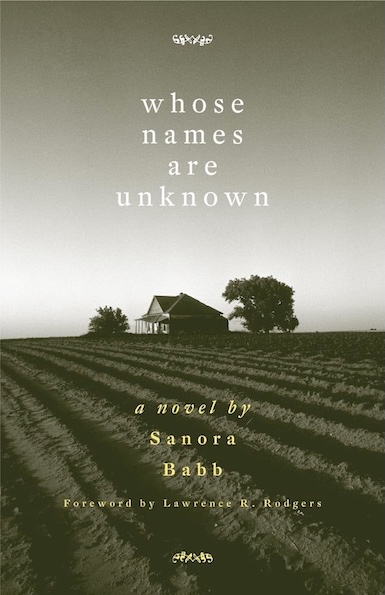
The title Whose Names Are Unknown reflects the eviction notices on the doors of failed farmers. It’s the story of farming families and their neighbors, with all their dreams and aspirations. With Babb’s background as a poet and short story writer, she chose the exact word to captivate hearts and minds.
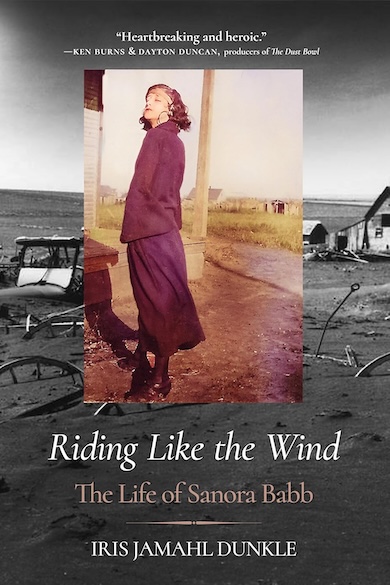
In Riding Like The Wind: the Life of Sanora Babb, Iris Jamahl Dunkle describes a blatant instance of one writer stealing from another in telling how John Steinbeck obtained the material for writing The Grapes of Wrath:
“Little did Babb know that the copy of her field notes she would willingly give Steinbeck would not only inspire him as he began his third and final attempt at writing the Dust Bowl novel, but would also make the publishing of her own novel impossible. As she later reflected, ‘Tom Collins … had asked me to keep detailed notes of our work every day, of the people, things they said, did, suffered, worked. I thought it was for our work, or for him, but it was for Steinbeck’ and ‘Tom asked me to give him my notes. I did. Naïve me.’”
The Grapes of Wrath sold 450,000 copies within the first five months of its release in 1939. It won the National Book Award and a Pulitzer Prize. John Ford made it into a film in 1940. The book was a catalyst for bringing the plight of Dust Bowl migrants to the center of American conversation.
When Babb delivered her novel to Random House, the publisher felt the story was “exceptionally fine,” but explained that the market couldn’t support two Dust Bowl novels. Though it was quite a different novel from Steinbeck’s, the publication of Whose Names Are Unknown was canceled.
Babb worked her way through the disappointment, and returned to writing for newspapers, magazines, and small presses. The Best American Short Stories (1950) published her short story The Wild Flower before it was translated into twenty languages.
She also edited for friends and literary magazines. In the ensuing years, she became friends with Ralph Ellison, and joined a writers group that would gather for forty years. Ray Bradbury was also a regular participant.
She and husband James Wong Howe (whom she married in 1937, though the marriage wouldn’t be legally recognized until 1948, when the California Supreme Court overturned the state’s anti-miscegenation laws) owned and operated a star-studded Chinese restaurant in Chinatown. Her sister, Dorothy, was their bookkeeper.
. . . . . . . . . . .
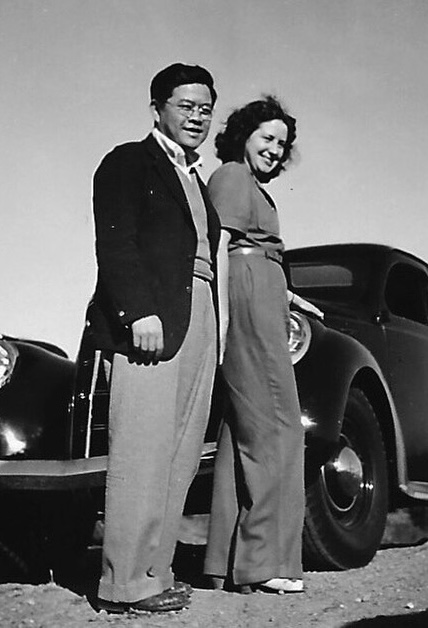
James Wong Howe and Sanora Babb (photo by Dorothy Babb, 1937)
. . . . . . . . . . .
In March 1958, The Lost Traveler was published in the United States and England. It was the second novel Babb’s had written (the first, of course, was Whose Names are Unknown), but her the first to be published.
With The Lost Traveler, Babb present a strong female character while also telling the story of a gambling father. After many rejections from publishers who preferred a gentler, more acquiescent female and upright father figure, she finally found a publisher who allowed her to tell the story in the way she wanted.
In his syndicated column, Literary Lantern, reviewer Caro Green Russell quotes Babb: “I feel very grateful to my father, who was a professional gambler, because the uncertain life he provided gave me so many and varied experiences from an early age …” and “We rode in wagons, and covered-wagons for trips; lived in a dugout in the ground, went to the creek for water for bathing, tried to farm without rain, and nearly starved.”
The April 14, 1958, Los Angeles Mirror newspaper gave The Lost Traveler a fair review, first a nod to the father in the story, Des, then to the family, and finally to the daughter, Robin. In the review, Bob Campbell wrote, in part:
“Sanora Babb has done a remarkable job of making the hero, Des Tannehill, sympathetic and understandable in spite of his occupation and occasional brutality. In fact, she has made the whole Tannehill family come alive, particularly Robin, the older daughter, the only member of the family with fortitude enough to stand up to her father.”
Babb refused to write complacent women and heroic men into her work to please publishers. Babb wrote about women and children who were too often at the mercy, whims, and fists of men. She committed to her singular goal, akin to Robin (the sixteen-year-old daughter of Des in The Lost Traveler), who tells her father she was alive with purpose:
“Well, I feel so alive I could burst!” She leaped up from the chair and whirled to the door, turning her back on him, pretending to look out, saying passionately, “I feel connected with everything, buffalo grass, meadow larks, lizards, rocks, wind — everything! I feel in tune with the universe!”
A few lines later, Robin tells Des about her feelings and dreams:
“I think they’re like seeds, moving in the ground, bursting with sprouts, ready to grow into beautiful and useful plants. Like wheat or a peach or a rose or even a weed.”
The Lost Traveler is full of rich, vibrant prose. Each word places the curious reader in the middle of the scene, designed to deliver a wealth of lived experiences to the poetic soul.
Throughout her writing career, Babb was quite faithful in looking after Dorothy, who suffered from mental issues. Babb was also painstaking in her care for her husband in a rather traditional fashion, often traveling to film locations all over the world as his career soared. She also continued to help her writer friends whenever they asked anything of her.
Best American Short Stories (1960) featured The Santa Ana, which first appeared in the Saturday Evening Post. It was described in the press as romantic and beautifully written with a “fine appreciation of the weather on human emotions.” (The Gazette, Cedar Rapids, Iowa, September 18, 1960)
In 1970, Babb published An Owl On Every Post, an autobiographical novel. She carefully altered the names and descriptions of the characters and some of the places. The book took more than ten years to write, but once published, it sold very well.
Babb was gratified to learn that so many people were reading the book, which described her family’s experiences in dry farming on the Great Plains from 1913 to 1917. For several years, Babb presented talks, attended luncheons, and gave interviews about An Owl On Every Post.
. . . . . . . . . . .
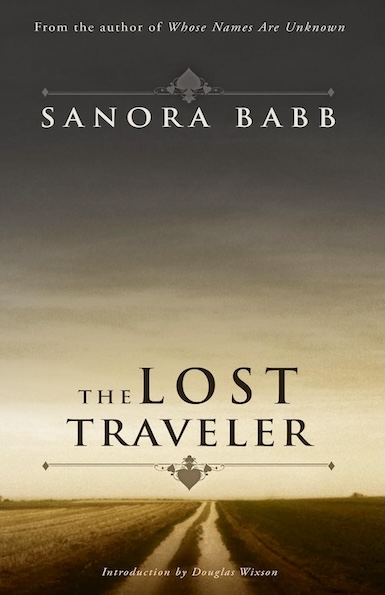
. . . . . . . . . . .
After her husband’s death in 1976, Babb dedicated several years to archiving his work. She went on to publish collections of her short stories: The Dark Earth; The Killer Instinct and Other Stories from the Great Depression (1987); Cry of the Tinamou: Stories (1997); and a collection of her poems, Told in the Seed (1998).
Not long after the publication of Whose Names Are Unknown, the extent to which Steinbeck used Babb’s research became known in literary circles. Her field notes, along with photos taken by Dorothy, are collected in a 2007 book, On the Dirty Plate Trail: Remembering the Dust Bowl Refugee Camp, arranged and presented by Douglas Wixson. Ken Burns’ 2012 documentary, The Dust Bowl features Babb and Whose Names Are Unknown.
Sanora Babb passed away in 2005, with a promise from her good friend, Joanne Dearcopp, to keep her works in print for as long as possible. Keeping to her word, Whose Names Are Unknown was finally published in 2006. Readers may prefer it to Steinbeck’s Grapes of Wrath for its humanity, its beauty, and its living, breathing life on the page.
Major works (novels and short story collections)
The post Sanora Babb, author of Whose Names are Unknown appeared first on Literary Ladies Guide.
]]>Well known for her 1980 novel The Salt Eaters, she was also hugely influential in the Black liberation and feminist movements. Her writing was inspired by the Black communities in which she lived and worked. She was concerned with injustice and oppression in general and of Black people in particular.
“A large repertoire of stories”: Growing up in Harlem
Toni was born in Harlem, New York. She spent her childhood and adolescence with her parents, Helen Brent Henderson Cade and Walter Cade, and her older brother, Walter Cade III, in Harlem and in Jersey City.
She changed her name from Miltona to Toni at the age of six. Much later, in 1970, she added the name “Bambara” – a national language of Mali and the name of a West African ethnic group, after seeing it inscribed in one of her great-grandmother’s sketchbooks.
Her mother encouraged her daughter in reading and the arts, and was a community activist in some of the organizations that sprung up in Harlem. That meant that music, theatre, writing, and activism were all bound up for Toni from an early age.
She was an average student in most subjects. Her fifth grade teacher at The Modern School, a private Black-run all-girls’ school in Harlem, reported that she was “not outstanding from either a scholastic or social point of view.” She did excel in creative writing, and she spent a lot of time at the New York Public Library. Later, she would cite poets Gwendolyn Brooks and Langston Hughes as major influences on her writing and her activism. Read More→
The post Toni Cade Bambara: Writer, Activist, Culture Worker appeared first on Literary Ladies Guide.
]]>Well known for her 1980 novel The Salt Eaters, she was also hugely influential in the Black liberation and feminist movements. Her writing was inspired by the Black communities in which she lived and worked. She was concerned with injustice and oppression in general and of Black people in particular.
Toni was born in Harlem, New York. She spent her childhood and adolescence with her parents, Helen Brent Henderson Cade and Walter Cade, and her older brother, Walter Cade III, in Harlem and in Jersey City.
She changed her name from Miltona to Toni at the age of six. Much later, in 1970, she added the name “Bambara” – a national language of Mali and the name of a West African ethnic group, after seeing it inscribed in one of her great-grandmother’s sketchbooks.
Her mother encouraged her daughter in reading and the arts, and was a community activist in some of the organizations that sprung up in Harlem. That meant that music, theatre, writing, and activism were all bound up for Toni from an early age.
She was an average student in most subjects. Her fifth grade teacher at The Modern School, a private Black-run all-girls’ school in Harlem, reported that she was “not outstanding from either a scholastic or social point of view.” She did excel in creative writing, and she spent a lot of time at the New York Public Library. Later, she would cite poets Gwendolyn Brooks and Langston Hughes as major influences on her writing and her activism.
Although Toni considered studying medicine, she graduated from Queens College in 1959 with a BA in Theatre Arts and English Literature. She was active in various forms of the arts in college, and was a member of its dance club, and in theatre groups where she took on backstage roles such as stage manager and costume designer. She also won the university’s John Golden Award for Fiction.
In 1961 Toni traveled to Europe. There, she studied Comedia dell’Arte at the University of Florence, and mime at L’Ecole de Mime Etienne Decroux in Paris. On her return to America, she completed an MA in Modern American Fiction from City University of New York.
Toni worked in social services to support herself, as a social worker at the Harlem Welfare Center and an occupational therapist in the psychiatric ward of the Metropolitan Hospital.
After completing her graduate studies in 1965, she was offered the chance to help with the development of City University’s SEEK (Search for Education, Elevation, Knowledge) program for economically disadvantaged students. She continued to teach there until 1969, when she was appointed assistant Professor of English at Livingston College (part of Rutgers University).
In 1970, she had a daughter, Karma Bene Bambara Smith, with her partner Gene Lewis.
. . . . . . . . . . .
. . . . . . . . . . .
Toni’s activism work and her writing grew side by side: “Writing,” she said, “is one of the ways I participate in transformation.”
In 1970, she edited and published one of the first major anthologies of Black women’s writing, The Black Woman. It included well-known and celebrated writers like Audre Lorde, as well as some of her undergraduate students and other unknown writers, all of whom were underrepresented in the male-dominated civil rights movement and in the white-dominated feminism movement.
This was followed in 1971 by Tales and Stories for Black Folks, which celebrated what she called “our great kitchen tradition.” Toni was one of a group of Black women fiction writers in the 1970s, including Alice Walker and Toni Morrison. The latter would become her editor and a lifelong friend.
Her debut collection of short stories, Gorilla, My Love, was published in 1972, and her first novel The Salt Eaters (1980) won the American Book Award and the Langston Hughes Society Award. Another collection of short stories, The Sea Birds Are Still Alive, was published in 1977, and another novel Raymond’s Run in 1990.
Toni Cade Bambara’s stories were set in either the rural South or the urban North, and use dialect to portray the lives of African Americans (often activists) and their communities. She consciously used language to try and explore the Black experience:
“…there have been a lot of things going on in the Black experience for which there are no terms, certainly not in English, at this moment. There are a lot of aspect of consciousness for which there is no vocabulary, no structure in the English language which would allow people to validate that experience through language. I’m trying to find a way to do that.”
Toni Morrison said of her writing, “[It] is woven, aware of its music, its overlapping waves of scenic action, so clearly on its way … like a magnet collecting details in its wake, each of which is essential to the final effect.”
At the same time, Toni was involved in Black and women’s liberation. She envisaged multicultural movements that crossed geographical boundaries, and in the early 1970s, she traveled to Cuba and Vietnam to learn from and forge connections with women’s organizations these countries.
In 1974 Toni moved with her daughter to Atlanta, Georgia. Old family connections were part of her reason for moving: “My people are from Atlanta. My mama’s folks are from Atlanta. My Daddy’s folks are from Savannah. I’ve always been very at home in the South…”
There she taught writing and Afro-American Studies at Spelman College, Emory University and Atlanta University, and became involved in the Black Arts Movement as a writer-in-residence at the Neighborhood Arts Center. When Spelman turned down her proposal for a course specifically on Black women writers, she began to teach it from her home. This gathering became the Pamoja Writing Workshop, which later turned out award-winning writers such as Shay Youngblood and Nikky Finney.
Fellow Atlanta writer Pearl Clearge recalled that Toni said “that she didn’t like to call herself an artist because then it made you start acting precious like you were so above everybody else, that she thought we should call ourselves cultural workers because we were no better than people who worked in factories, no better than people who taught school, no better than people who were nurses and doctors and all of that. We were cultural workers.”
. . . . . . . . . .
. . . . . . . . . .
Between 1979 and 1981, a spate of about forty child kidnappings and murders — teens and young adults, mostly boys — rocked the Black community in Atlanta. Toni got involved in helping to disseminate accurate information, organizing neighborhood patrols, and monitoring the media amidst a climate of fear and mistrust.
Out of this came what many consider to be her finest novel, Those Bones Are Not My Child, originally titled If Blessings Come and published posthumously in 1999 by Toni Morrison. It was a testament to the power of Toni Cade Bambara’s passion for activism that had become the hallmark of her work.
In a 1982 interview with Kay Boneti of the American Audio Prose Library, Toni said, “When I look back at my work with any little distance the two characteristics that jump out at me is one, the tremendous capacity for laughter, but also a tremendous capacity for rage.”
In 1985 she relocated to Philadelphia, and taught film script writing at the Scribe Video Center. Alongside Louis Massiah, the founder of the Center, she worked on various documentaries. She sometimes produced, wrote, or narrated, and sometimes all three — including The Bombing of Osage Avenue (1985), and Seven Songs for Malcolm X (1993).
Toni was diagnosed with colon cancer in 1993. She continued to work, and one of her final projects was the 1995 documentary W.E.B. DuBois: A Documentary in Four Voices.
Upon her death in 1995, the New York Times called her a “major contributor to the emerging genre of contemporary black women’s literature.” She was posthumously inducted into the Georgia Writers’ Hall of Fame in 2013, and since 2000, Spelman College has hosted an an annual Toni Cade Bambara Scholar-Activism Conference to honor her legacy of involvement in activism.
In 2025, the film TCB – The Toni Cade Bambara School of Organizing was released to critical acclaim, and won two documentary prizes at the BlackStar Film Festival. Directed by Louis Massiah and Monica Henriquez, it’s an intimate account of her life, told through archival footage, sound recordings, photos, animation, and interviews with her family, friends, students, and fellow writers and editors.
Major works
Short story collections
Novels
Screenplays (produced)
Anthologies and biography
The post Toni Cade Bambara: Writer, Activist, Culture Worker appeared first on Literary Ladies Guide.
]]>This overview of the life and work of Bessie Head is an introduction to this notable literary figure who was instrumental in gaining a more international voice for African peoples.
A complicated early Life
Bessie was born in a psychiatric hospital where her mother, Bessie Amelia Emery, was institutionalized, and where she remained for the rest of her life. As reported by South Africa’s Sunday Times Heritage Project:
“According to the racial legislation of the time, Bessie was classified as white and was placed with a white adoptive family. However, her racial identity later became blurred as the white family’s lawyer noted: ‘The child is Coloured, in fact quite black and Native in appearance.” The state authorities hastily removed Bessie and placed her under the care of a ‘Coloured’ adoptive family, George and Nellie Heathcote.”
Bessie was removed from the Heathcote’s home by social services around the age of twelve. This started the process of feeling alienated from her heritage, stemming from the fact that she was considered mixed race or ‘coloured’ under the South African government’s racial classification.
Documented in a letter to her publisher for a never-completed autobiography, she wrote that she was “as anxious to avoid any knowledge of my mother’s white relatives as they were anxious to destroy my mother and disown me.”
Early journalism and writings
Bessie began teaching in Durban, KwaZulu-Natal, and held the position from 1956 to 1958. Read More→
The post Bessie Head: Botswana and South Africa’s Shared Literary Great appeared first on Literary Ladies Guide.
]]>This overview of the life and work of Bessie Head is an introduction to this notable literary figure who was instrumental in gaining a more international voice for African peoples.
Bessie was born in a psychiatric hospital where her mother, Bessie Amelia Emery, was institutionalized, and where she remained for the rest of her life. As reported by South Africa’s Sunday Times Heritage Project:
“According to the racial legislation of the time, Bessie was classified as white and was placed with a white adoptive family. However, her racial identity later became blurred as the white family’s lawyer noted: ‘The child is Coloured, in fact quite black and Native in appearance.” The state authorities hastily removed Bessie and placed her under the care of a ‘Coloured’ adoptive family, George and Nellie Heathcote.”
Bessie was removed from the Heathcote’s home by social services around the age of twelve. This started the process of feeling alienated from her heritage, stemming from the fact that she was considered mixed race or ‘coloured’ under the South African government’s racial classification.
Documented in a letter to her publisher for a never-completed autobiography, she wrote that she was “as anxious to avoid any knowledge of my mother’s white relatives as they were anxious to destroy my mother and disown me.”
Bessie began teaching in Durban, KwaZulu-Natal, and held the position from 1956 to 1958. Her first newspaper job was working for the Golden City Post in Cape Town. Around 1959, she joined Home Post at their Johannesburg offices.
She was inspired by the writing of Mohandas Gandhi and Robert Sobukwe, (the founding member of the Pan Africanist Congress (PAC). Her letters would compare Gandhi and his writing to being Godlike, and she particularly admired his contributions to civil rights that might have well inspired her own.
In 1960, Bessie joined the Pan Africanist Congress. Because it was a banned organization under the South African apartheid government, she was arrested. Although charges were later dropped, this event is said to have been the driving force behind her first suicide attempt.
Returning to Cape Town, she founded and published The Citizen newspaper. Bessie established a close association with District Six and the coloured community. She mixed with prominent figures that would influence her life and writing, including jazz musician Abdullah Ibrahim (then known as Dollar Brand).
The apartheid government would later gain control of The Citizen and other newspapers in an operation dubbed Operation Muldergate. Attempting to purchase these magazines, the government believed they could have a stronger hold on public opinion – and directly counteract the anti-apartheid motions of authors like Bessie Head.
. . . . . . . . . .
. . . . . . . . . .
Bessie met Harold Head in 1961, and they married six weeks later. Their marriage was an unhappy one from the start, and she soon began to seek any escape from her troubled and depressed home life. Her son was later diagnosed with fetal alcohol syndrome — a consequence of her stressed, erratic lifestyle during her pregnancy.
Some of Bessie’s later poems, written around 1961–1962, were discovered in 1995. These were donated to the National English Literary Museum in Grahamstown, South Africa.
She finished writing her first novel, The Cardinals, in 1962. However, it was published only after her death. The Cardinals tells of a girl named Mouse, who is sold by her birth mother – and who later runs away from home after being abused by her stepfather. The book is one of her only novels set in South Africa, and takes place in Cape Town during the 1950s.
Bessie left Cape Town at the end of 1963 and moved into her mother-in-law’s house in Atteridgeville, Pretoria. She described the circumstances of her marriage while living in her mother-in-law’s house and attempting to gain a teaching job as being “at the edge of despair and terror.” She also tried to get a teaching job in Uganda; however, her passport was refused, possibly due to her earlier involvement with the PAC.
Bessie’s marriage ended in 1964. She left for Serowe with her son to start a new life in Botswana on a one-way exit permit. She returned to her teaching background at Tshekedi Memorial School.
Starting a new life in Serowe wasn’t easy, and due to her political affiliations, it took fifteen years to gain legal citizenship in Botswana. Her teaching job only lasted a year and a half. In a letter, she stated that a lack of respect for women in the workplace was the reason for her dismissal.
Her letters also reveal that she often asked friends for money or extensions on loans that they had given her. As a thanks to some, she reportedly enclosed some of her original writing within these letters. She was a prolific letter writer, and some of her letter collections have received as much attention as her other writings. – including her writings to South African poet Patrick Cullinan and his wife, Wendy.
Her letters have been studied more in recent years. A study by Annie Gagiano (Writing a Life in Epistolic Form: Bessie Head’s Letters) points to her early childhood letters, where she “takes on the role of social commentator” that she would occupy for life.
. . . . . . . . . .
. . . . . . . . . .
When Rain Clouds Gather (1968) tells the story of a political refugee named Makhaya, who flees to Botswana and settles in a rural town called Golema Mmidi. Makhaya comes to meet the English agricultural expert Gilbert Balfour, who joins forces to introduce new technology and farming techniques to the village.
Around 1969, Bessie began to experience symptoms of depression and schizophrenia, which led to her hospitalization in Lobatse Mental Hospital. After this episode, she wrote A Question of Power (1973). Bessie wrote in a letter to her agent that this book had drawn from her mental health and anxiety at the time.
A Question of Power is one of Bessie Head’s best-known works and is considered semi-autobiographical. The main character, named Elizabeth, leaves South Africa to live in Botswana. Many of her experiences seem to draw directly from Bessie’s life.
Maru (1971) tells the story of historical racial discrimination between the Setswana and San peoples. Head speaks from the perspective of Margaret Cadmore, a member of the San/Basarwa people, and shares her experiences as teacher in the village of Dilepe – where her people face brutal discrimination.
In 1977, she published the short story collection The Collector of Treasures. Serowe: Village of the Rain Wind (1981) was a personal perspective on Botswana – the place she set most of her stories, and where she felt most at home. Bessie Head’s last novel, A Bewitched Crossroad (1984) was set in Botswana, spanning from 1800 to 1895, and explored the Sebina clan.
. . . . . . . . . .
. . . . . . . . . .
Bessie lived with her son until her death from hepatitis in April 1986. She passed away at Sekgoma Memorial Hospital in Serowe.
Much of her acclaim arrived later in life, and today she is considered a literary legend in both Botswana and Southern Africa. Bessie was awarded the national Order of Ikhamanga posthumously in 2003 for her contribution to literature. In 2007, the Bessie Head Heritage Trust and Bessie Head Literature Awards were established to further her legacy.
In 2013, the Bessie Head Heritage Trust recommended that the Serowe library be named after her, as she had been an active member of the library during her lifetime. Her papers are archived at the Khama III Memorial Museum in Serowe.
. . . . . . . . . .
Contributed by Alex Coyne, journalist, author, and proofreader. He has written for a variety of publications and websites, with a radar calibrated for gothic, gonzo and the weird. His features, posts, articles and interviews have been published in People Magazine, ATKV Taalgenoot, LitNet, The Citizen, Funds for Writers, and The South African, among other publications.
More by Alex Coyne on this site
The post Bessie Head: Botswana and South Africa’s Shared Literary Great appeared first on Literary Ladies Guide.
]]>Palestinian women writers, like other women writers across the globe, did not have it easy, especially those who lived through the Nakba. This was the 1948 catastrophe when more than 700,000 Palestinians were displaced from historical Palestine (modern day Israel) to Gaza, the West Bank, Jordan, Syria, and Lebanon.
Added to this displacement were societal pressure and cultural norms that put women at a disadvantage compared to their male peers.
Early life in Nablus
Fadwa Tuqan is now known as “the poetess of Palestine.” She was born in Nablus, a city in northern Palestine, in 1917, into an affluent family who lived in a large home inherited from their ancestors.
Fadwa grew up in a male-dominant household and society, and was shunned by her father — he was hoping his newborn would be a boy. Her mother tried to abort her and threw the “burden” of raising Fadwa onto their housemaid. Her mother took away all her dolls when she was eight, and when Fadwa shared stories using her imagination her mother would brush them off as “nonsense.”
. . . . . . . . . . .

House of Al-Bayk Tuquan, courtesy of Yalla Falasteen
. . . . . . . . . . .
Many of her writings described the environment and male-dominated society she grew up in, where “women were prisoners between walls.” Though her family was wealthy and could easily afford her schooling, Read More→
The post Fadwa Tuqan: From Societal Suppression to Poetess of Palestine appeared first on Literary Ladies Guide.
]]>Palestinian women writers, like other women writers across the globe, did not have it easy, especially those who lived through the Nakba. This was the 1948 catastrophe when more than 700,000 Palestinians were displaced from historical Palestine (modern day Israel) to Gaza, the West Bank, Jordan, Syria, and Lebanon.
Added to this displacement were societal pressure and cultural norms that put women at a disadvantage compared to their male peers.
Fadwa Tuqan is now known as “the poetess of Palestine.” She was born in Nablus, a city in northern Palestine, in 1917, into an affluent family who lived in a large home inherited from their ancestors.
Fadwa grew up in a male-dominant household and society, and was shunned by her father — he was hoping his newborn would be a boy. Her mother tried to abort her and threw the “burden” of raising Fadwa onto their housemaid. Her mother took away all her dolls when she was eight, and when Fadwa shared stories using her imagination her mother would brush them off as “nonsense.”
. . . . . . . . . . .
House of Al-Bayk Tuquan, courtesy of Yalla Falasteen
. . . . . . . . . . .
Many of her writings described the environment and male-dominated society she grew up in, where “women were prisoners between walls.” Though her family was wealthy and could easily afford her schooling, her brother Yousef removed her from the education system while she was in elementary school due to “societal pressures;” he found out that a boy who was fond of Fadwa was following her home from school.
Her brother Ibrahim went off to study literature at the American University of Beirut in Lebanon. After his graduation in 1929, he was determined to help his sister continue her studies. He taught Fadwa the art of rhyming in Arabic poetry. She began submitting her poems to literary magazines in Cairo and Beirut under pseudonyms, gaining self-confidence as her work was accepted and published.
Ibrahim Tuqan, who became a reknowned Palestinian poet in his own right, writing the Arab national poem “Mawtini” (now the national anthem of Iraq), was the only one of her brothers that fully supported her.
. . . . . . . . . . .

. . . . . . . . . . .
In 1939, Fadwa left Nablus to live with Ibrahim in Jerusalem, where she finally broke free of the walls in which her family had confined her for so long. In Jerusalem, Fadwa was introduced to a society of poets, writers, and politicians, became active in literary and cultural clubs, and started going to the library and cinema.
In A Mountainous Journey: A Poet’s Autobiography, Fadwa wrote about her difficult and unfair life, including how she contemplated suicide multiple times. In Jerusalem, she began taking English lessons at an evening school at the YMCA so that she could begin reading and self-studying English Literature.
In 1962, Fadwa moved to London for two years where she took courses in English and Literature at Oxford University continuing her self-development and learning journey.
Upon returning from London, Fadwa decided to claim her autonomy, away from the confines of her family and the society in which she had grown up. She built her own house in the west of Nablus, where she continued to live independently.
As with her poetry, she knew her family would never accept her marriage to a stranger from another country. Her first love was Egyptian lyricist and poet Ibrahim Naja, about whom she had written some of her best poetry. Their relationship remains alive through her poetry for him and the love letters they had exchanged.
. . . . . . . . . . .

Stamp commemorating Fadwa’s centenary
. . . . . . . . . . .
EXISTENCE
Translated by Michael R. Burch
In solitary life, I was a lost question;
In the encompassing darkness,
my answer was concealed.
You were a bright new star
radiating light from the darkness of the unknown,
revealed by fate.
The other stars rotated around you
—once, twice —
until it came to me,
your unique radiance.
Then the bleak blackness broke
And in the matching tremors
of our two hands
I found my missing answer.
Oh you! Oh you intimate, yet distant!
Don’t you remember the coalescence
Of your spirit in flames?
Of my universe with yours?
Of the two poets?
Despite our great distance,
Existence unites us – Existence!
Fadwa witnessed the Nakba in 1948 and didn’t remain silent. She was part of the Jordanian delegation for a peace conference organized by the World Peace Council in Stockholm and later delegations to Holland, the Soviet Union, and China. After the death of her beloved brother and mentor Ibrahim in 1941, her father urged her to write political and national poetry to steer her away from the emptiness she was feeling after losing Ibrahim.
But she resisted and instead published her first poetry collection in 1946, My Brother Ibrahim, as a way to grieve her loss. It was only after her father’s death in 1948 that she start writing nationalist and resistance poetry without anyone’s influence.
Her resistance poetry had such an impact that Moshe Dayan, commander of the Jerusalem front in the 1948 Arab-Israeli war said that Fadwa’s poetry was the equivalent of facing twenty enemy fighters.
MY SAD CITY
translated by Charlie Huntington
“On the day of Zionist occupation”
The day we saw the death and deception,
The floods fell back,
The windows to heaven closed,
And the city held its breath.
Day the waves retreated, day that
The ugliness of the abyss
Exposed its face to the light.
Hope burned
As an agony of misfortune strangled
My sad city.
Gone are the children and songs;
Not a glimpse, not an echo
The sorrow in my city crawls shamefully,
Staining her steps.
The silence in my city –
Silence like mountains at rest,
Like a dark night, a painful silence
Burdened with the weight of death and defeat.
Alas! Oh, my sad, silent city
Are you thus at harvest time,
Your crops and fruits aflame?
Alas! Oh, what an end!
Alas! Oh, what an end!
Fadwa is considered a feminist of her time; although she was forced to leave elementary school and never completed her education with a degree, she fought her way through her life and career becoming the first Palestinian female poet, publishing eight poetry collections between 1946 and 2000.
Selections of her poetry have been translated into more than five languages, including Hebrew, and her two autobiographies, A Mountainous Journey and The Most Difficult Journey, were translated and published in English in 1990 and 1993 respectively.
. . . . . . . . . . .

. . . . . . . . . . .
A Mountainous Journey is a compilation of all her journal entries until 1967. In The Most Difficult Journey she speaks of her life under the occupation after the Palestinian Nakba in 1948 and the 1967 Naksa. A documentary of her life was produced by Palestinian Novelist Liana Badr titled Fadwa: A Poetess from Palestine. Her life was featured on Al Jazeera Documentary, and Ilam Media also produced a short film about her after her death. You can watch it here with English subtitles.
On December 12, 2003, Fadwa passed away in her hometown of Nablus, leaving behind a legacy of political activism, literature, and a new path for Palestinian women writers to follow.
. . . . . . . . .
Contributed by Lama Obeid, a writer from Palestine. Her poem “My Father a Refugee” has been published in the anthology To Lay Sun into a Forest, published by Sidhe Press. Lama enjoys experimenting with poetry and fiction, and hopes to become a published author of an anthology and a memoir in the future. Lama also publishes her writing on her Substack, I Come From There.
Further reading
The post Fadwa Tuqan: From Societal Suppression to Poetess of Palestine appeared first on Literary Ladies Guide.
]]>In 1967, she published her first children’s book, Jennifer, Hecate, Macbeth, William McKinley, and Me, Elizabeth. That same year, her second book, The Mixed-Up Files of Mrs. Basil E. Frankweiler, was also published. (Photo above right by Ron Kunzman)
E.L. Konigsburg’s first book won the 1968 Newbery Honor, and her second won the 1968 Newbery Medal. Though not written at the same time, both were published the same year due to an interesting turn of events.
When school libraries received a substantial increase in funding, an enormous backlog of books was sent to the printing presses. After catching up with this backlog, the publisher printed both of Konigsburg’s books, making it possible for her to have two titles published in the same year.
As it turned out, both titles made the Newbery Medal list: a winner and a runner-up. Konigsburg was the only author to have ever achieved that milestone. In 1997 she won the Newbery for her 13th book, The View from Saturday.
With this award, Konigsburg joined Joseph Krumgold, Lois Lowry, Katherine Paterson, Elizabeth George Speare, and Kate DiCamillo as the only authors to win more than one Newbery. The Newbery Medal is an award granted each year by the American Library Association for the most distinguished American children’s book.
. . . . . . . . . . .
. . . . . . . . . . .
Early life and background
Elaine Lobl was born in New York on February 10, Read More→
The post E.L. Konigsburg, Children’s Book Writer who “Dared to Disturb the Universe” appeared first on Literary Ladies Guide.
]]>In 1967, she published her first children’s book, Jennifer, Hecate, Macbeth, William McKinley, and Me, Elizabeth. That same year, her second book, The Mixed-Up Files of Mrs. Basil E. Frankweiler, was also published. (Photo above right by Ron Kunzman)
E.L. Konigsburg’s first book won the 1968 Newbery Honor, and her second won the 1968 Newbery Medal. Though not written at the same time, both were published the same year due to an interesting turn of events.
When school libraries received a substantial increase in funding, an enormous backlog of books was sent to the printing presses. After catching up with this backlog, the publisher printed both of Konigsburg’s books, making it possible for her to have two titles published in the same year.
As it turned out, both titles made the Newbery Medal list: a winner and a runner-up. Konigsburg was the only author to have ever achieved that milestone. In 1997 she won the Newbery for her 13th book, The View from Saturday.
With this award, Konigsburg joined Joseph Krumgold, Lois Lowry, Katherine Paterson, Elizabeth George Speare, and Kate DiCamillo as the only authors to win more than one Newbery. The Newbery Medal is an award granted each year by the American Library Association for the most distinguished American children’s book.
. . . . . . . . . . .
. . . . . . . . . . .
Elaine Lobl was born in New York on February 10, 1930, to Jewish-Hungarian parents Adolph and Beuhlah Klein Lobl. The family soon moved to Pennsylvania, where Elaine would spend a majority of her growing-up years in small mill towns such as Farrell, a company town that had formed when several steel mills converged in the South Sharon area in the early 20th century.
At its peak in 1920, the population of Farrell was 15,586, but the time the Lobls moved there in the 1940’s, the population was steadily declining. Like many mill towns across the country during the Great Depression, there was less demand for steel; therefore fewer mill jobs. During WWII, production at the mills revved up to produce the steel used for making helmets, aircraft, ammunition, and myriad other products for the war.
The background to Elaine’s teen years was punctuated with a regular blast from industrial whistles and the thudding and scraping of metal against metal as the mills met the war’s demands. The Lobl family made their home above the store they maintained and, thanks to the resurgence of the steel industry, managed fairly well.
As a child, Elaine loved school so much that she felt that getting A’s was what she was best at in life. Because she wasn’t very good at music or sports, she was glad that those were only pass/fail classes, so that she could maintain her A’s. Elaine also loved to read. Her favorite books were the works of Jane Austen, as well as Frances Hodgson Burnett‘s The Secret Garden, and P.L. Travers‘ Mary Poppins. She often read in the bathroom, locking the door to extend her privacy.
Living above the family store, a random sulfuric whiff from the mill tingeing the air, Elaine wished she could find books to read with people like her, like her family – not just books with people who had maids and butlers and sophisticated language.
During the Depression, Elaine’s father lost his job, money was scarce, and the Lobl family moved in with relatives for a time. Elaine wished for books she could relate to. In high school, Elaine practiced her love for drawing and developed a passionate interest in science. She was the editor of the school newspaper and the valedictorian of her class.
From 1947 to 1948, Elaine worked as a bookkeeper for the Shenango Valley Provision Company, a meat plant in Sharon, Pennsylvania. There she met the man who would later become her husband, David Konigsburg, the brother of one of the owners. At this job, Elaine managed to earn enough money to pay tuition for her first year at the Carnegie Institute of Technology (now Carnegie Mellon University).
She studied chemistry while working many odd jobs. She also learned how to apply for scholarships and how to receive work-study assistance, so she raise enough funds to pay for school. She graduated with honors with a BS in chemistry in 1952.
After graduation, Elaine married David Konigsburg before starting graduate school at the University of Pittsburgh. David’s work as an industrial psychologist drew the couple to Florida, and Elaine began teaching chemistry at a girls’ private school, where she discovered that she was more interested in what was going on in the students’ heads than inside the test tubes.
. . . . . . . . . . .
. . . . . . . . . . .
The Konigburgs had three children, and when the family moved to New York in the early 1960’s, the youngest daughter began school. Konisburg was left to ponder what to do with her newly found free time. She knew she wanted to do something creative and decided to give children’s book writing a try.
She wanted to write books for children around the ages of 8 to 12 because she felt it to be a time when children seek acceptance from their peers – both by being like everyone else and by being different from everyone else.
So, with pencil in hand, she drew her characters, wrote their stories, and found the path through reconciling these struggles faced by children.
Jennifer, Hecate, Macbeth, William McKinley, and Me, Elizabeth, and The Mixed-Up Files of Mrs. Basil E. Frankweiler, were books about people like her own children and characters her own children could relate to. And, as it turned out, not just her own children, but many, children who were able to relate to E.L. Konigsburg’s characters – proven by the continued success of the books.
In a 1986 talk at Florida Community College at Jacksonville, Konigsburg gave an inspiring presentation full of literary nuggets. In her speech, she included many astute scientific observations, but one of the larger takeaways from the talk was when she stated that those who dare to disturb the universe must first have the courage to disturb the neighborhood.
Though Konigsburg’s speech was punctuated with the creative processes involved in scientific exploration, it was nestled in the fantastic prose from the words of T.S. Eliot‘s famous poem, The Love Song of J. Alfred Prufrock, when he wrote:
I grow old … I grow old …
I shall wear the bottoms of my trousers rolled.
Shall I part my hair behind? Do I dare to eat a peach?
I shall wear white flannel trousers, and walk upon the beach.
It was Konigsburg’s observation that in order to disturb the universe, in order to do the human things that humans should do in their time on earth, they must engage their creative impulse. Konigsburg uses examples of Galileo, Newton, and Einstein to illustrate how people must often struggle against popular thought in order to accomplish what they know to the very core of themselves to be true.
In her speech, Konigsburg melded science and fantasy, blended Einstein’s microscope with Eliot’s meter, with poise and grace and intention, because “… any creative act disturbs the universe,” and disturbing the universe is a uniquely human thing to do, something that, perhaps, humans are supposed to do. Why else would humans be creative? Be it cooking, decorating, mathematical reasoning, arts, crafts, engineering, science, etc. humans are creative and, as logic dictates, should disturb the universe in their time on earth.
Konigsburg, then, was more than a writer and illustrator of award-winning children’s books. She was also an astute philosopher, historian, and speaker, reaching a level of noted genius not all writers achieve.
Konigsburg published a collection of her speeches in 1995, TalkTalk, a children’s book author speaks to grown ups. The topics range from why children’s books matter to where ideas come from to finding the courage to disturb the universe. The book is sprinkled with full-color images and immersed in many deeply expansive scientific and historical observations. A melding of science, philosophy, and art, it’s a true Elaine Lobl Konigsburg original.
E.L. Konigsburg passed away in 2013 at the age of 83. Her last children’s book was published in 2011, marking a forty-four-year span of a writing life. She wrote books that won prestigious awards, were translated into dozens of languages, and made into movies and plays. Her twenty-four books include nineteen novels (some of which she illustrated), two picture books (both illustrated by her), and three nonfiction books.
Contributed by Tami Richards, a history enthusiast and freelance writer living in the Pacific Northwest. More of her work can be found here.
Further reading
The post E.L. Konigsburg, Children’s Book Writer who “Dared to Disturb the Universe” appeared first on Literary Ladies Guide.
]]>